Decoding Wire Labels: What ISI, FR, FRLS, HFFR and HR Actually Mean
The wire labels printed along a cable’s sheath tell you everything you need to buy with confidence — once you can read them.
A Label on a Box Is Also a Promise
Every house wire box sold in India is covered in acronyms ISI, FR, FRLS, HFFR, HR, EBXL. Each one represents a specific test, a specific standard, and a specific promise about how the wire will behave when something goes wrong. Almost no homeowner can read them all. Most electricians won’t volunteer the difference. And the price gap between the labels usually outweighs their importance in a buyer’s mind.
This guide decodes every label that matters and shows you exactly how to read a wire box before you buy.
ISI Mark: The Baseline of Trust
The ISI mark, issued by the Bureau of Indian Standards (BIS), confirms that the wire meets IS 694:2010 — India’s standard for PVC-insulated cables up to 1100V. If a wire doesn’t carry the ISI mark, it has no business being in your home. Every APAR wire is certified to IS 694:2010 and tested well beyond its minimum requirements.
FR — Flame Retardant
FR insulation is engineered to be self-extinguishing meaning the fire stops once the original ignition source is removed. Key technical markers: Oxygen Index above 29% and Temperature Index above 250°C. The APAR Shakti FR PVC is engineered to exceed both.
FRLS / LSH — Flame Retardant, Low Smoke (Low Halogen)
FRLS adds two critical properties on top of FR: reduced smoke density (≤60%) and reduced acid gas emission (≤20%) during a fire. Why this matters: smoke kills more people in house fires than flames do. APAR’s Shakti FR LSH and the premium Shakti Green Wire HR FR LSH PVC are engineered for spaces where families spend the most time.
HFFR — Halogen-Free Flame Retardant
HFFR is the top tier of fire-safe insulation. It contains zero halogen, so even during intense burning it releases almost no corrosive acid gas (≤0.5%) and produces minimal smoke (≤10% density). The APAR Anushakti Fire Protekt EBXL HFFR (XZ) sits at this tier and is widely regarded as one of India’s safest house wires.
HR — Heat Resistant
HR refers to insulation that can operate continuously at higher temperatures — typically up to 105°C, sometimes 120°C — without softening or degrading. This matters for high-load circuits (ACs, geysers, induction cooktops) where the wire stays warm under sustained current. APAR’s Anushakti HR FR LSH combines heat resistance with low-smoke and zero-halogen safety.
EBXL — Electron Beam Crosslinked
EBXL is the manufacturing process that gives a wire its premium properties. APAR is the first Indian manufacturer to commercialise Electron Beam (E-Beam) Technology, which crosslinks insulation polymers at a molecular level using high-energy electrons. The result: 50–100% higher current capacity, superior thermal resistance, mechanical strength, and a service life of 70 years versus 25 for standard PVC.
How to Read a Wire Box Like a Pro
- Look for the ISI mark and the IS number (IS 694:2010 for house wires).
- Read the insulation type — FR, FRLS, or HFFR — and match it to the room’s risk profile.
- Look for HR if the wire will carry a high continuous load.
- Check for EBXL or E-Beam markings if you want crosslinked insulation.
- Verify the manufacturer’s name and batch details — and ask for the test certificate.
In Summary
The labels on a wire box exist for a reason — each one is a test passed, a property guaranteed, a layer of safety added. The next time you stand at the counter choosing house wires, read the box like you read a food label. Your home deserves at least the same scrutiny as your dinner.
Reading wire labels at a glance
Wire labels carry the brand, conductor size, voltage grade, the IS standard and the ISI licence mark. Grade codes like FR, FRLS, HFFR and HR tell you the fire behaviour. Learning to read wire labels is the simplest way to confirm you are getting genuine, correctly specified cable.
More on wire grades and labels
- FR, FRLS or HFFR: which one belongs behind your walls. Picking a grade for your own home, room by room.
- HR-FR-LSH vs FR-PVC. The two most common grades compared head to head.
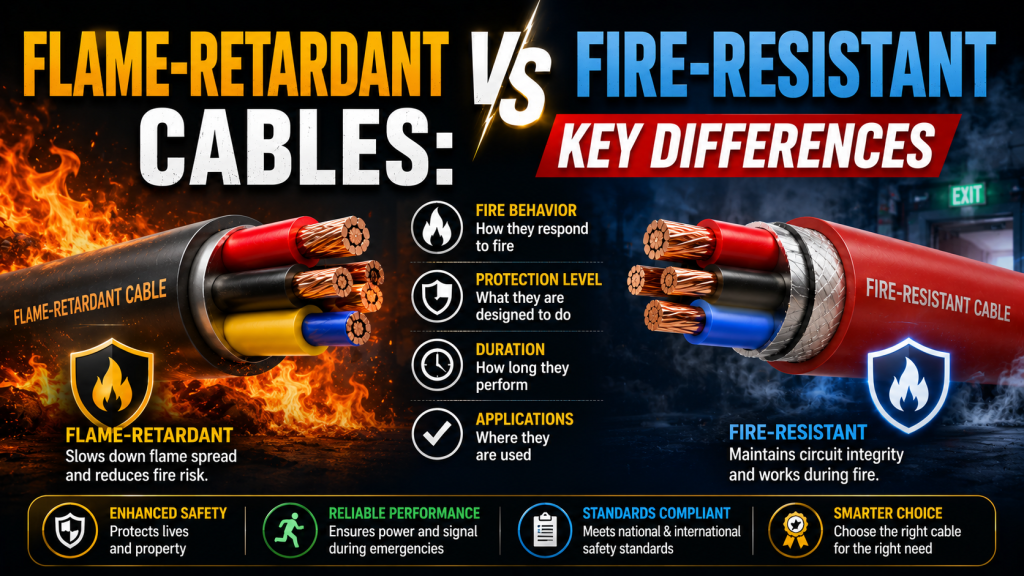
- Flame-retardant vs fire-resistant. Two phrases that get used as if they mean the same thing. They do not.
- Grade selection chart. A one-page reference you can keep open at the counter.
- APAR house wires by grade. FR, FR-LSH, HR-FR and halogen-free HFFR, with specifications.