CCTV & Cable-TV Wiring: Choosing the Right Coaxial Cable
Surveillance systems and cable television both rely on coaxial cable — but the right type and quality make the difference between a crisp picture and a noisy, dropping signal. Here’s a practical guide.
What makes coaxial cable special
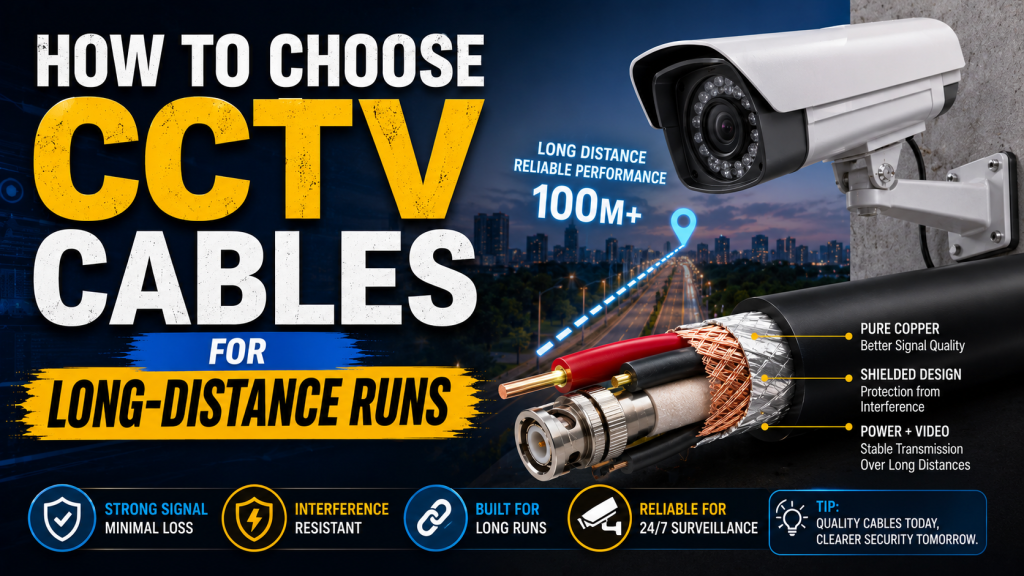
A coaxial cable has a central conductor wrapped in a dielectric, a conductive shield and an outer sheath. That shield is the key — it blocks external electromagnetic interference so high-frequency video and RF signals travel cleanly over distance.
CCTV wiring
Analog CCTV cameras typically use an RG-59 ‘3+1’ cable — a coaxial video core plus three power cores in one run, so a single cable carries both video and power. Quality conductors and shielding give clear, distortion-free footage. See which cable CCTV cameras need and APAR Tarang Shakti CCTV cable. (IP cameras instead use LAN cable.)
Cable-TV wiring
CATV cable is coaxial too, tuned for low signal loss and anti-interference over distribution runs so the picture stays sharp. See APAR Tarang Shakti CATV cable.
Practical tips
Use purpose-built cable rather than generic wire, keep runs within recommended lengths, and avoid running coax alongside heavy power cables. Browse all communication cables or contact us.
Choosing the right coaxial cable
The right coaxial cable depends on the signal and the distance. For CCTV, RG59 is the long-standing choice for analog and short HD runs, while RG6 carries higher frequencies further with less loss — better for cable TV, satellite and longer camera runs. Look at the conductor (solid copper outperforms copper-clad steel where power runs over the coax), the shielding (more braid coverage means better noise rejection) and the run length, since every metre costs a little signal. Matching the coaxial cable to the job keeps the picture crisp and the connection stable, whether for a single camera or whole-home distribution.