E-Beam Wires vs Conventional PVC Wires
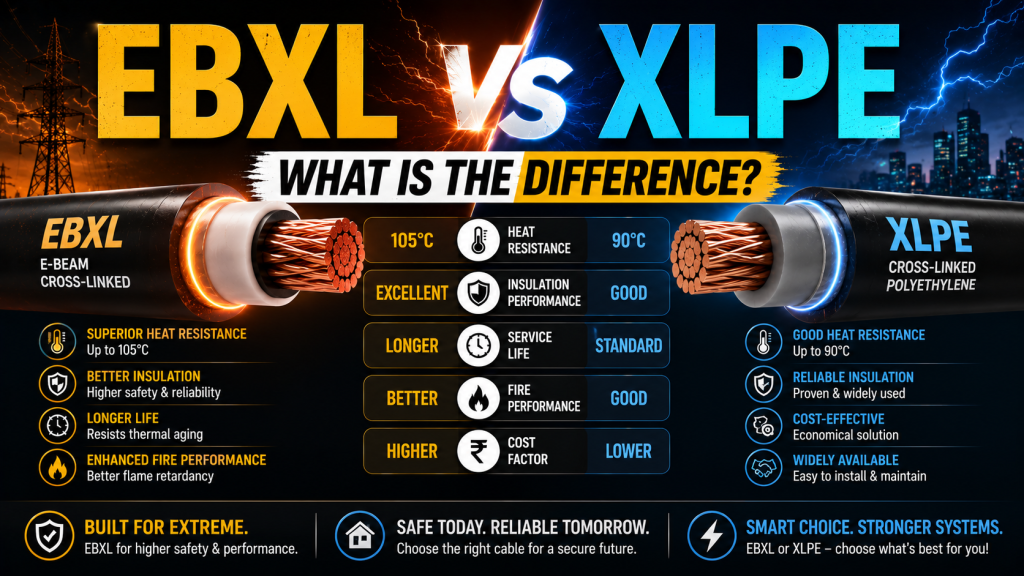
- Ordinary PVC wire is thermoplastic — it softens and can melt as it heats. An e-beam (EBXL) wire is cross-linked, so it does not melt and withstands far more heat.
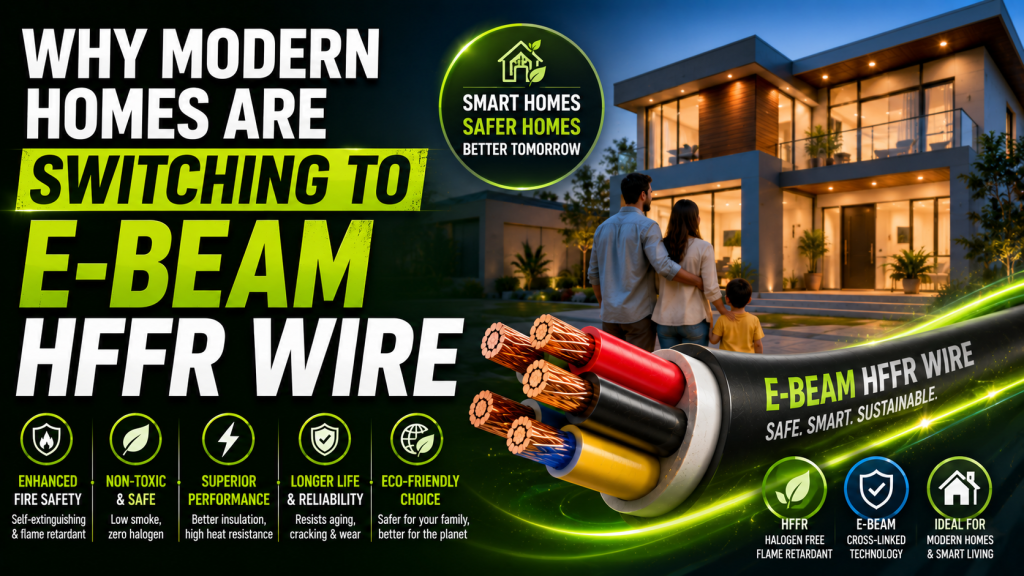
- E-beam wires last longer, tolerate higher temperatures, and — with HFFR compounds — emit low smoke and no corrosive halogen gases in a fire.
- PVC remains cheaper and fine for standard use; e-beam is the premium, fire-safe upgrade for homes that prioritise safety and longevity.
On this page:
- What is a conventional PVC wire?
- What is an e-beam (EBXL) wire?
- E-beam vs PVC — side by side
- Is e-beam wire worth it for a home?
- FAQs
What is a conventional PVC wire?
A conventional house wire uses PVC (polyvinyl chloride), a thermoplastic insulation. Flame-retardant grades — FR and FR-LSH — improve how it behaves in a fire, but the base polymer is still thermoplastic: it softens and can melt and drip at high temperatures (typically rated around 70–90 °C).
What is an e-beam (EBXL) wire?
An e-beam wire has its insulation cross-linked by an electron beam, bonding the polymer into a heat-stable, melt-resistant network. APAR’s Anushakti Fire Protekt EBXL pairs this process with an HFFR (halogen-free) compound, so the wire resists heat, does not melt, and stays low-smoke and halogen-free in a fire.
E-beam vs PVC — side by side
| Feature | Conventional PVC wire | E-beam (EBXL) wire |
|---|---|---|
| Insulation type | Thermoplastic PVC | Cross-linked (thermoset-like) |
| Behaviour in heat | Softens; can melt and drip | Does not melt — melt-resistant |
| Temperature class | ~70–90 °C | Higher (105 °C+ class) |
| Smoke & halogen in a fire | Emits smoke; halogen (reduced in LSH grades) | HFFR: very low smoke, zero halogen |
| Design life | Standard | Longer — APAR cites up to a 50-year design life |
| Relative cost | Lower | Premium |
| APAR product | Shakti FR-PVC | Anushakti Fire Protekt EBXL HFFR |
Is e-beam wire worth it for a home?
If fire safety and longevity matter to you — concealed wiring you won’t easily replace, homes with children or elderly family, or simply peace of mind — an e-beam HFFR wire is a worthwhile upgrade: it won’t melt, it holds up to heat, and it protects escape routes by staying low-smoke and halogen-free. For lighter-duty or budget wiring, a quality FR / FR-LSH PVC house wire remains a sound choice. Not sure what size to use? Try our wire-size calculator.
FAQs
Does an e-beam wire really not melt?
Correct. Cross-linking turns the insulation into a network that chars instead of melting and dripping, unlike thermoplastic PVC — a genuine fire-safety advantage.
What is the “50-year life” claim about?
Cross-linked, e-beam insulation ages far more slowly than thermoplastic PVC, so APAR rates the Fire Protekt range for a much longer service life than conventional wire.
Is e-beam wire worth the extra cost?
For concealed, hard-to-replace wiring and safety-critical spaces, most people find the one-time premium worthwhile over a wire that lasts decades. For temporary or light loads, standard FR-PVC is fine.
Can I mix e-beam and PVC wires in one home?
Yes — many homes use e-beam HFFR on main and safety-critical circuits and FR-PVC elsewhere. An electrician can advise on the right split.