Why Modern Homes Are Switching to E-Beam HFFR Wire
More and more modern homes are choosing e-beam HFFR wire, and the reasons go well beyond the marketing.
The electrical load of an average Indian home has changed dramatically. Air-conditioners, geysers, modern kitchens, home offices and now EV chargers all draw more current, for longer — and that is pushing homeowners and builders toward electron-beam (e-beam) HFFR house wire.
What e-beam technology adds
E-beam cross-linking bonds the insulation’s polymer chains into a thermoset structure. Compared with ordinary PVC, that delivers:
- higher heat resistance and far more current-carrying capacity for the same wire size;
- melt resistance — the insulation will not soften or drip, even at very high temperatures;
- excellent short-circuit performance and a service life measured in decades.
Safer in a fire
HFFR insulation is halogen-free and low-smoke, so in a fire it releases far less toxic gas than PVC. Combined with melt resistance, that meaningfully lowers fire and short-circuit risk in the wall.
Built for tomorrow’s loads
Because e-beam wire runs cooler and carries more current, it copes comfortably with heavy modern circuits and leaves headroom for future additions like an EV charger. It is also cheaper to install quality wire during construction than to rewire later.
The upgrade
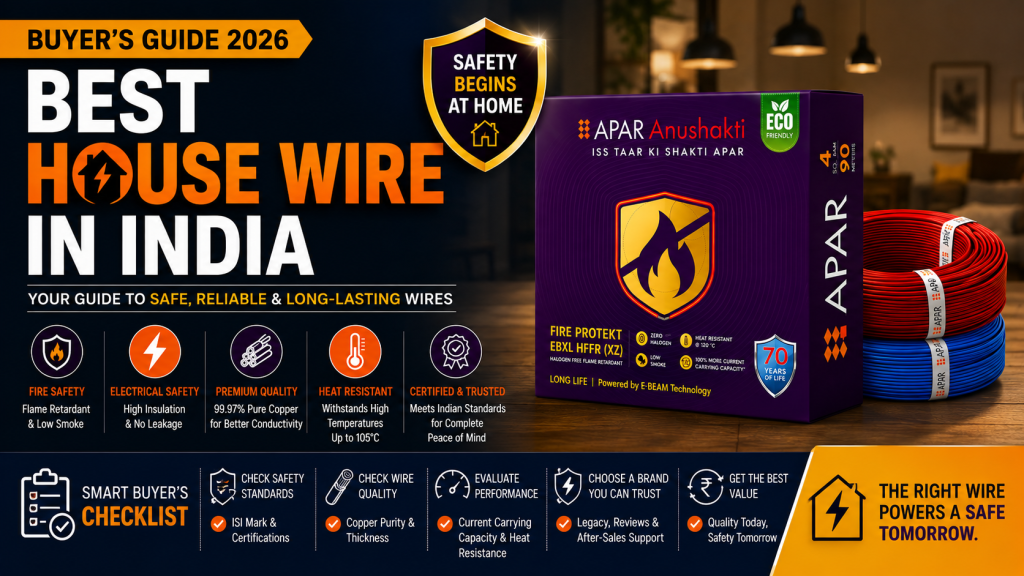
APAR Anushakti Fire Protekt offers up to 100% more current-carrying capacity, halogen-free fire safety and a decades-long life. Explore the full house wires range or contact APAR.
What sets e-beam HFFR wire apart
Two technologies combine here. HFFR (halogen-free flame-retardant) insulation resists flame and gives off very little smoke and no toxic halogen gas. Electron-beam (e-beam) cross-linking then locks the insulation’s molecules together, which sharply raises its heat resistance, short-circuit endurance and working life. The result is a house wire that tolerates higher temperatures, survives fault currents better and lasts far longer than ordinary PVC — APAR’s Fire Protekt is built this way. For a home you expect to live in for decades, e-beam HFFR wire is an upgrade that pays back in safety and longevity.