How to Choose CCTV Cables for Long-Distance Runs
Over long runs, a CCTV cable faces two problems: the video signal weakens on the coax, and power drops on the copper cores. Choosing the right cable type, pure-copper conductors and a sensible power strategy keeps the picture clean and the camera powered.
- Use a heavier coax (RG-6) instead of RG-59 for longer video runs, and always use bare copper, not copper-clad aluminium.
- Plan for voltage drop — power the camera locally, use a higher-gauge power core (e.g. 4+1), or a higher-voltage supply, on long runs.
- For very long distances, consider a UTP + balun setup or fibre; keep runs away from heavy electrical cables to avoid interference.
On this page:
- Why distance is a problem
- How to choose CCTV cable for long runs
- Getting power to a distant camera
- FAQs
Why distance is a problem
Coaxial cable attenuates (loses) the video signal the further it travels, and thin power cores lose voltage over distance — a camera that works fine at 20 m can flicker or go dark at 150 m. The quality of the copper matters too: copper-clad aluminium (CCA) has higher resistance than bare copper, so it loses both signal and power faster.
How to choose CCTV cable for long runs
| Run length (analog) | Recommended |
|---|---|
| Up to ~100 m | Good-quality RG-59 (bare copper), 3+1 |
| ~100–250 m | RG-6 coax, 4+1, bare copper; consider local power |
| Beyond ~250 m | UTP + video balun, or fibre; power the camera locally |
Whatever the length, use bare copper conductors, avoid joints (each joint adds loss), and route the cable away from mains power and motors to limit interference. Our Tarang Shakti CCTV cable uses annealed tinned-copper for clean, distortion-free video.
Getting power to a distant camera
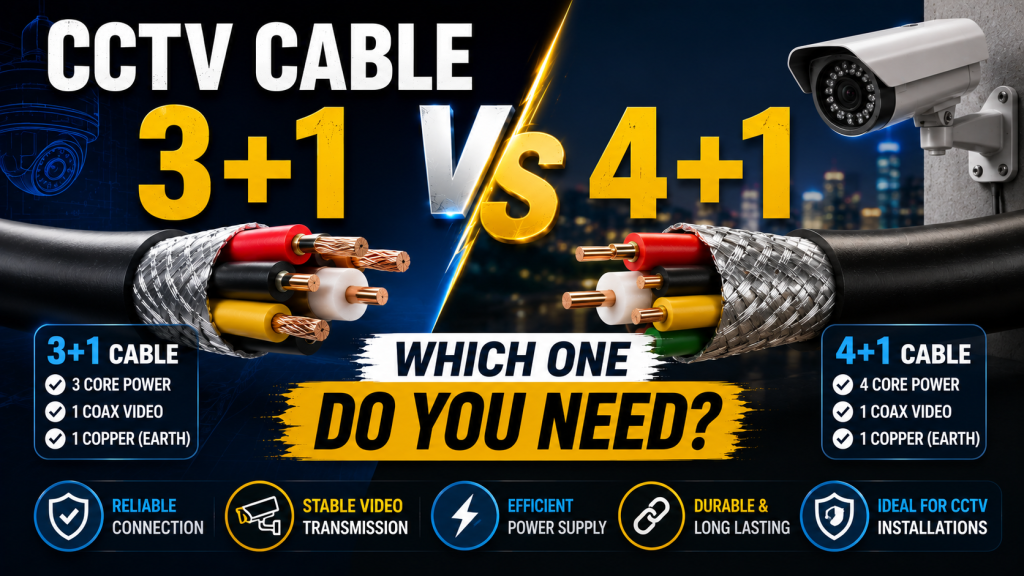
The most common failure on long runs is not the video — it’s the power. Options: power the camera from a local adapter near it (best for very long runs); use a 4+1 cable so a thicker/second copper core carries the current; or use a centralised higher-voltage supply designed for voltage drop. Read 3+1 vs 4+1 for the power-core comparison.
FAQs
How far can a CCTV cable run?
Good RG-59 handles roughly 100 m of analog video; RG-6 stretches further. Beyond ~250 m, UTP-plus-balun or fibre is more reliable, with local power at the camera.
Why does my distant camera lose power or picture?
Usually voltage drop or signal loss — often from thin or copper-clad-aluminium conductors and long runs. Use bare copper, a heavier cable, or local power.
Is RG-6 better than RG-59 for CCTV?
RG-6 has a thicker core and lower loss, so it’s better for longer runs; RG-59 is fine and cheaper for shorter distances.
Does copper-clad aluminium (CCA) work for CCTV?
It’s cheaper but has higher resistance, so it loses signal and power faster — bare copper is strongly preferred, especially on long runs.