
Cable Solutions · Fibre Optic Cables
Ribbon cables duct, armoured & aerial
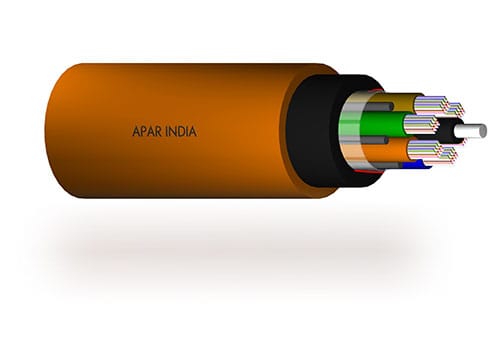
Ribbon optical cables are used for duct, direct buried, and aerial installations.
Fibre count48F – 1152F
ConstructionsDuct, armoured and aerial
JacketsSingle and double
Operating temperature−40°C to +70°C
✓ 48F – 1152F
✓ Ribbon
✓ Duct / aerial
✓ EN 187000
Description
OverviewThis is a stranded loose tube cable with optical fibres placed inside robust buffer tubes stranded around a fibre-reinforced plastic (FRP) central strength member. In addition to optical fibres, the buffer tubes contain water-blocking gel and the cable core is surrounded with a water-swellable tape to prevent water ingress in the interstices of the cable core. Glass roving yarns are distributed over the inner sheath, and a thermoplastic jacket provides the cable with both mechanical and environmental protection. Application Ribbon optical cables are intended for duct, direct-buried, and lashed aerial installations. These cables are used for fibre networks where a high fibre count is required. Ribbon fibre optic cables can be used in indoor FTTH networks and indoor/outdoor point-to-point applications. Characteristics These cables are lighter compared to the old gel-filled cables. This all
Why this wire
Key benefits Highest fibre density 48F to 1152F in ribbon configuration.
Duct, armoured and aerial One ribbon platform across all three.
Mass fusion splicing Ribbon format speeds up jointing.
Steel tape armour Single jacket steel tape armoured variants available.
Characteristics
At a glance| Application | Ribbon optical cables are intended for duct, direct-buried, and lashed aerial installations. These cables are used for fibre networks where a high fibre count is required. Ribbon fibre optic cables can be used in indoor FTTH networks and indoor/outdoor point-to-point applications. |
|---|---|
| Characteristics | These cables are lighter compared to the old gel-filled cables. This allows for easier cable handling, easy mid-span entry, and superior fibre access. |
| Applicable standards | IEC 60793, IEC 60794, Telcordia GR -20, TIA/EIA 598 |
| Product range | From 4F fibre up to 1000 single mode fibres in full compliance with ITU-T-G.652.D in 4/6/8/12 fibre ribbon (also available with G655 / G656 / G657 SM Fibre and OM1 / OM2 / OM3 & OM4 MM Fibre). These cables can be provided with unarmoured ducts for underground applications, ADSS for aerial use and armoured cables for direct buried applications. |
| Advantages | These cables are more installer-friendly, and lighter in weight than conventional gel-filled cables, and hence allow for easier handling, mid-span entry, and provide superior fibre accessibility. The first advantage of a ribbon fibre jumper is the ability to save time and reduce installation cost. Since the cables are pre-banded (usually made up of 12 sets of separate fibres), installers and technicians can perform simpler, faster mass fusion stitching so that all fibres in the ribbon matrix can be stitched together at the same time. This means less installation time, lower installation labour costs, and faster recovery during downtime. The second benefit of the ribbon fibre cable is the increased fibre density of the cable. Fibre density is an important benefit as it increases the fibre count at the data centre. |
Construction
Cutaway123
- 1ConductorStranded, sized and specified for the application
- 2InsulationCompound selected for the product type and temperature rating
- 3Printed identificationGrade, size, voltage and applicable standard
Standards & approvals
ComplianceManufactured and tested to IEC 60793, IEC 60794, EIA/TIA, ITU-T, Telcordia GR-20, EN 187000. Test certificates and detailed technical particulars are issued on request — please confirm the specification your project is tendered against.
IEC 60793IEC 60794EIA/TIAITU-TTelcordia GR-20EN 187000
Applications
Where it's usedTelecom networksData connectivityBroadband & FTTHCampus networks
Not sure which size you need?
Open calculator →Use the APAR Wire-Size Calculator to size a circuit in seconds.
Documents
DownloadsFAQs
Good to knowTypical applications include telecom networks, data connectivity, broadband & ftth, campus networks. Contact our technical team to confirm suitability for your specification.
Ribbon optical cables are intended for duct, direct-buried, and lashed aerial installations.
Use the enquiry form on this page or the Request a Quote option, and APAR's team will respond with availability and details for your requirement.
Sizing or selecting a cable? Browse our guides & charts →
Request information
Get a quoteRequest a quote
Tell us your requirement — our team will get back to you.
Enquiry about: Ribbon cables duct, armoured & aerial · Fibre Optic Cables
✓ We reply within 1 business day✓ No spam — your details are used only for this enquiry
Get Ribbon cables duct, armoured & aerial
Enquire for pricing, request the datasheet, or apply to become an authorised dealer.