
Cable Solutions · Fibre Optic Cables
Unitube fibre optic cables
Unitube fibre optic cable - compact, economical and easy to handle.
BrandDuctoFib
Fibre count1F – 48F (unitube)
InstallationBlowing, pulling or lashed aerial
Operating temperature−40°C to +70°C
✓ 1F – 48F
✓ Duct
✓ UL / CPR
✓ Blown or pulled
Description
OverviewFibre optic cables use light pulses to transfer data signals up to hundreds of miles and they have a higher bandwidth and throughput than conventional electrical communication cables. In today’s advanced environment, fibre optic cables are the main source of communication between organisations with multiple sites, telecom companies, and many other such long distance communication applications that require higher bandwidth and longer distance transmission. The type of optical fibre to be used is dependent on the application, the distance which the signals are required to travel, and the speed of transmission. The installation and environmental requirements also decide the cable construction. This includes (but is not limited to) indoor applications within a dry wall in a public area, which may or may not have special LSZH materials, and installations along railway tracks. APAR’s customise
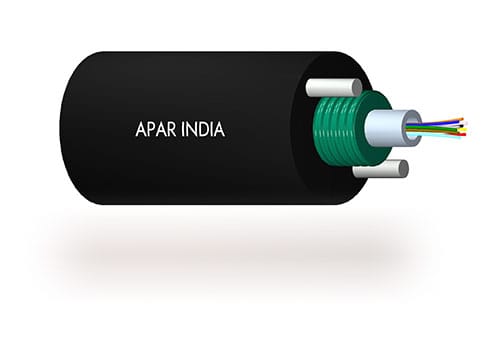
All fibres sit in a single central gel-filled tube, giving a small diameter and low weight. A cost-effective choice for duct and aerial routes with moderate fibre counts.
Why this wire
Key benefits Small and light Easy to install in ducts, high flexibility.
Blowing or pulling Suits either duct installation technique.
UL and CPR ratings Available on request.
High tensile and crush resistance With UV protection for outside plant.
Wet or dry Rated for either environment.
Characteristics
At a glance| Application | Applications range from carrying telephone calls (up to several million calls per cable) to high-speed data transfer for vast computer networks. |
|---|---|
| Characteristics | For critical applications, our range of cables are available in fire-resistant (IEC 60331) versions, and can also be made for customer-specific requirements. |
| Applicable standards | IEC 60793, IEC 60794, Telcordia GR -20, TIA/EIA 598 |
| Product range | Under Unitube Optical Cables, APAR offers the following types of cables: duct and direct-buried underground cable, aerial, ADSS and Figure 8 cables for overhead applications, and cables for indoor use in micro ducts/conduits from 2 fibres to 24 fibres. We also offer customer-specific composite and hybrid cables with single mode and multi mode fibres. |
| Advantages | Fibre optic cables support and run a huge part of the global internet services in a more efficient and effective manner than standard copper cables. Fibre optic cables, with the similar thickness of standard copper cables, support a higher bandwidth, and transmit data over longer distances, allowing telecom network providers to reach remote locations across the globe. |
Construction
Cutaway123
- 1ConductorStranded, sized and specified for the application
- 2InsulationCompound selected for the product type and temperature rating
- 3Printed identificationGrade, size, voltage and applicable standard
Standards & approvals
ComplianceManufactured and tested to IEC 60793, IEC 60794, EIA/TIA, ITU-T, Telcordia GR-20. Test certificates and detailed technical particulars are issued on request — please confirm the specification your project is tendered against.
IEC 60793IEC 60794EIA/TIAITU-TTelcordia GR-20
Applications
Where it's usedTelecom networksData connectivityBroadband & FTTHCampus networks
Not sure which size you need?
Open calculator →Use the APAR Wire-Size Calculator to size a circuit in seconds.
Documents
DownloadsFAQs
Good to knowApplications range from carrying telephone calls (up to several million calls per cable) to high-speed data transfer for vast computer networks.
Use the enquiry form on this page or the Request a Quote option, and APAR's team will respond with availability and details for your requirement.
Sizing or selecting a cable? Browse our guides & charts →
Request information
Get a quoteRequest a quote
Tell us your requirement — our team will get back to you.
Enquiry about: Unitube fibre optic cables · Fibre Optic Cables
✓ We reply within 1 business day✓ No spam — your details are used only for this enquiry
Get Unitube fibre optic cables
Enquire for pricing, request the datasheet, or apply to become an authorised dealer.