
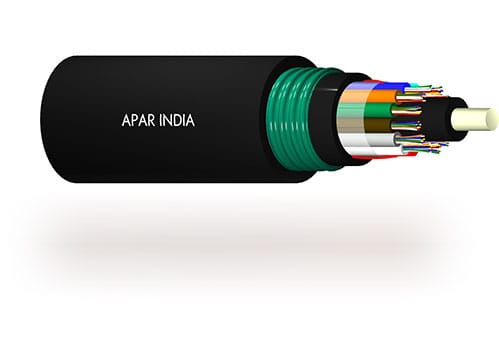
Composite cables
Description
OverviewThanks to our experience and expertise in cables, APAR can customise composite fibre optic cables to suit different applications. APAR’s customised cables cater to high-bandwidth applications of data centres, global internet companies, ISPs and telcos, citizen network services and installations along the railway tracks. We offer a wide range of cables, including aerial, underground, micro duct, ribbon, IO and indoor, last mile connectivity and special application cables. Composite cables are those cables in which two or more types of fibres are held in one cable. Fibre counts and the type of optical fibre to be used varies by the application, the distance signals are required to travel and the speed of transmission. The cable construction depends on various factors like the environmental conditions at the installation site, whether the use is indoors or outdoors, where it is to be used w
A composite cable carries power, signal, data or optical elements within a single sheath, engineered to the customer's functional requirements where separate cables are impractical.
Why this wire
Key benefitsCharacteristics
At a glance| Application | Fibre optic cables are used for a wide range of applications: from carrying telephone calls (up to several million calls per cable) to high speed data transfer for vast computer networks. |
|---|---|
| Characteristics | For critical applications, APAR fibre optic range of cables are available in fire resistant (IEC 60331) versions, in addition to other specific requirements. |
| Applicable standards | IEC 60793, IEC 60794, Telcordia GR -20, TIA/EIA 598 |
| Product range | Under multi loose tube optical cables, APAR offers the following types: Direct buried, duct and aerial, and cables for indoor use in conduits 2-512 fibres per cable; 1-24 fibres per filled loose buffer tube Custom and composite cables Composite single and multi mode fibres |
| Advantages | Fibre optic cables play an important role in running global internet services, in an efficient and effective manner. Fibre optic cables are much superior to standard copper cables, as fibre optic cables of same thickness support higher bandwidth capacity and can transmit data over longer distances. It allows telecom network providers reach remotest locations across the globe. |
Construction
Cutaway- 1ConductorStranded, sized and specified for the application
- 2InsulationCompound selected for the product type and temperature rating
- 3Printed identificationGrade, size, voltage and applicable standard
Standards & approvals
ComplianceManufactured and tested to IEC 60793, IEC 60794. Full test certificates and detailed specifications are available on request for project submittals.
Applications
Where it's usedUse the APAR Wire-Size Calculator to size a circuit in seconds.
Documents
DownloadsFAQs
Good to knowFibre optic cables are used for a wide range of applications: from carrying telephone calls (up to several million calls per cable) to high speed data transfer for vast computer networks.
Use the enquiry form on this page or the Request a Quote option, and APAR's team will respond with availability and details for your requirement.
Sizing or selecting a cable? Browse our guides & charts →
Request information
Get a quoteRequest a quote
Tell us your requirement — our team will get back to you.
Enquire for pricing, request the datasheet, or apply to become an authorised dealer.