Why Your Builder’s “Standard Wiring” Might Be Costing You More Than You Think
Your builder’s ‘standard wiring’ might look fine on day one and still cost you later — here is what that phrase often hides.
The Quiet Trap of “Standard Wiring”
When you buy a flat in a new project, “standard wiring” appears as a single line item in the brochure. You assume it covers everything safety, quality, capacity, longevity. In practice, it usually means the cheapest IS-694-compliant FR PVC wire the developer could source, sized for today’s average load and nothing more.
That standard works for a few years. Then the bills creep up, appliances start failing, and one summer afternoon the AC trips repeatedly. By then, the wires are inside the walls and replacing them means breaking them open.
What “Standard Wiring” Usually Covers
In most Indian residential projects, builder-grade wiring means:
- 1.0 sq.mm to 2.5 sq.mm copper FR PVC wires for general circuits
- Minimal differentiation between low-load and high-load zones
- FR (flame retardant) grade not FRLS or HFFR
- Standard PVC insulation, not E-Beam crosslinked
- No future-load planning for EVs, induction stoves, or additional ACs
It meets code. It does not meet the realistic load profile of a modern Indian household over a 25-year horizon.
The Four Hidden Costs of Basic Builder-Grade Wiring
1. Higher Electricity Bills, Year After Year
Lower-purity copper and thinner cross-sections mean higher conductor resistance and resistance becomes heat, and heat becomes wasted energy. Premium wires like the APAR Shakti Green Wire HR FR LSH PVC use 99.97% pure copper for 100% conductivity, reducing line losses across every circuit in your home.
2. Heat Damage to Expensive Appliances
Sustained heat in undersized wires shortens the life of every appliance plugged into the circuit. ACs, refrigerators, and inverters all run hotter, fail sooner, and need replacement years before they should.
3. No Headroom for the Next Decade of Load
If you add an EV charger, a second AC, or an induction stove, basic wiring will struggle. The cost of retrofitting wiring through finished interiors can run into lakhs. The cost of specifying better wiring at construction stage is a few thousand rupees per circuit.
4. Compromised Fire Safety in High-Risk Zones
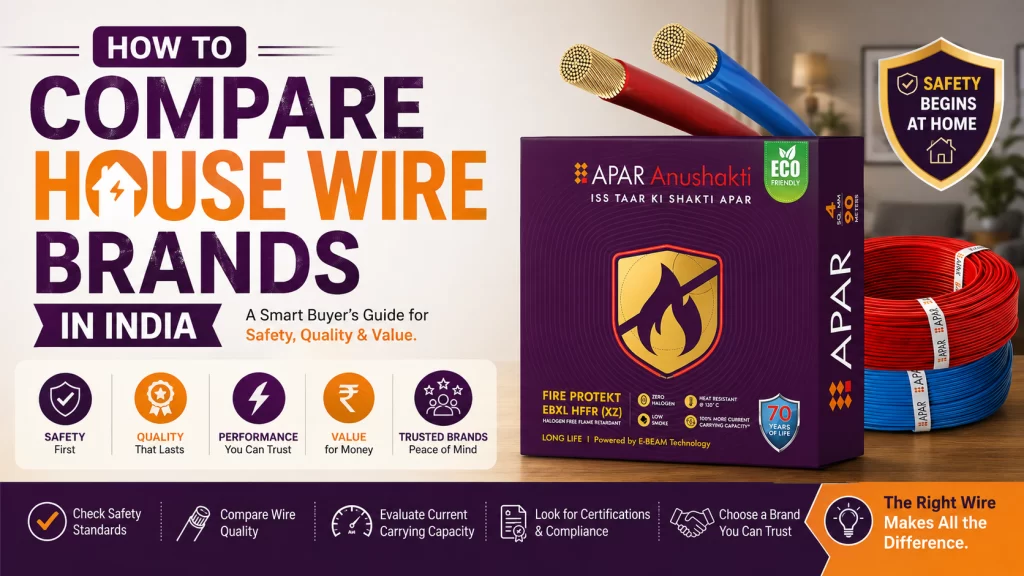
Basic FR wires slow flames but emit dense smoke and corrosive gas when burning. In a high-rise apartment, that is a critical evacuation problem. HFFR wires like the APAR Anushakti Fire Protekt EBXL HFFR (XZ) emit less than 10% smoke density and almost zero acid gas — the difference between a difficult evacuation and a survivable one.
The Upgrade Checklist for a Smarter Spec
- Specify FRLS for bedrooms, living rooms, and kitchens (Green Wire HR FR LSH PVC).
- Specify HFFR for ACs, geysers, kitchens, and high-rise common areas (Anushakti Fire Protekt).
- Demand E-Beam engineered wires for any high-load circuit — they last 70 years versus 25 for standard PVC.
- Build in 30% load headroom on every circuit.
- Insist on continuity and insulation testing before handover.
In Summary: A Few Thousand Rupees, Two Decades of Peace
The price difference between standard and upgraded wiring across an entire 2 or 3 BHK apartment is genuinely small a fraction of a percent of the total construction cost. The difference in safety, energy efficiency, appliance lifespan, and future-proofing is enormous. Treat your wiring specification as a one-time decision with twenty-five years of compounded consequences. Because that is exactly what it is.
What ‘standard wiring’ really means
Standard wiring is usually chosen to hit a price, which can mean basic PVC wire, minimal sizing and little thought to fire safety. It passes inspection but leaves no margin for heavy modern loads or a fault behind the wall. Insisting on better-grade, correctly sized cable is a small upgrade that pays back in safety.