Congested Corridors and Crossings: Where Covered Conductor Beats Bare Wire and Underground Cable
A bare 33 kV conductor strung through a narrow corridor leaves very little margin. One wind gust, one fallen branch or one climbing animal can bring two phases together or put a phase on earth, and the feeder trips. Moving the whole line underground removes that exposure, but it brings trenching, road reinstatement, jointing and a long outage-to-repair cycle of its own. Many distribution engineers are therefore looking for a middle option for the places where bare wire is too exposed and cable is too disruptive.
Medium voltage covered conductor (MVCC) is that middle option. It is not a replacement for either of the other two in every location. It earns its place in specific corridor types, and the decision is easier to make when those types are named plainly.
Why bare conductor struggles in tight corridors
A bare overhead line relies entirely on air for insulation. That is acceptable where the right of way is wide and clear. It becomes a liability when the corridor narrows or when something foreign can enter the gap between phases.
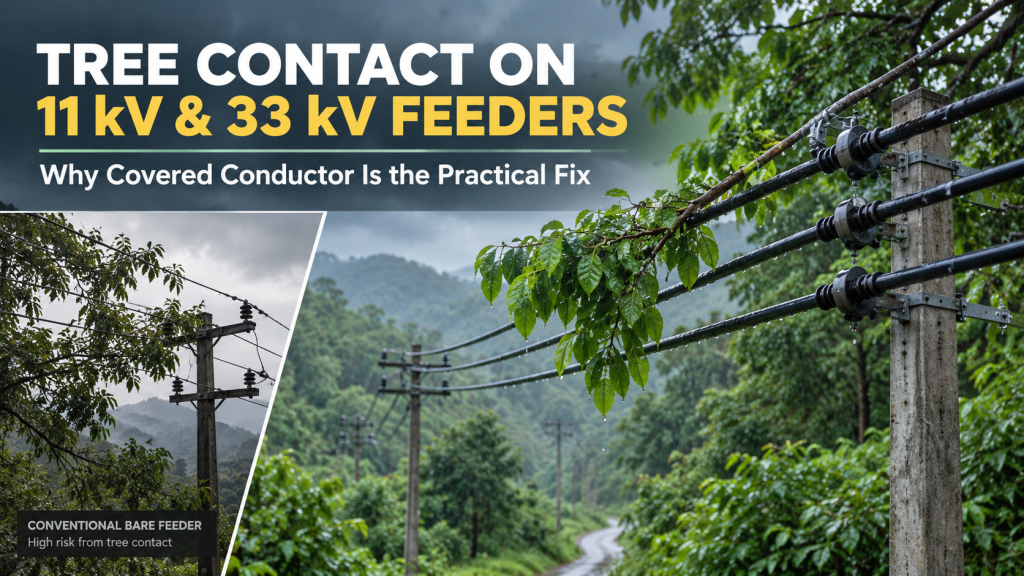
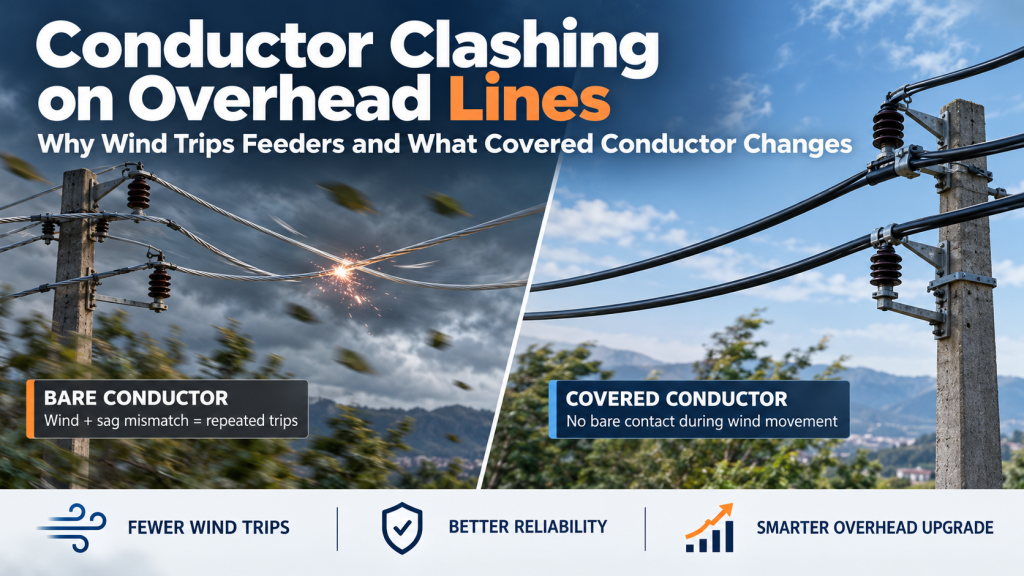
Three situations account for most of the trouble. One is vegetation: branches, creepers and windblown debris that touch or bridge conductors. Another is conductor clashing, where wind or fault current movement swings adjacent phases together. A third is accidental contact by people, animals or equipment in places where the line passes close to buildings, scaffolding or settlements.
The usual response with bare wire is to widen the clearances, trim more often and add more insulation at the pole. Each of those costs money and land. In congested areas the land is simply not available.
Why underground cable is not always the answer
Underground cable removes weather and vegetation from the picture. It does not remove cost or complexity. Trenching through a built-up area means permissions, traffic management and reinstatement. Crossing a river or railway means directional drilling or a structure. When a fault does occur, locating it and excavating to the joint or the damaged length takes longer than climbing a pole.
For high-density urban networks, underground still wins. APAR supplies MV and HV XLPE cables for exactly that purpose (see the MV and HV XLPE power cable range). The question this post addresses is narrower: what to do on the overhead routes that will stay overhead, but need better protection than bare wire can give.
What covered conductor changes
The APAR MVCC range is a single-core overhead conductor for 11 kV to 132 kV, covering six classes (11, 22, 33, 66, 110 and 132 kV), in conductor sizes from 100 to 400 sq mm. The conductor can be AAAC, ACSR, ACSS or AL59 ACS. Over the conductor, four layers are built up from the inside out: a longitudinally water-tight stranded conductor, a semi-conducting screen, an inner carbon-free XLPE insulation, and an outer UV-protected, anti-tracking black covering. The screen and both insulation layers are co-extruded and bonded together. The design follows SS-EN 50397-1.
That covering does not make the line safe to touch. A covered conductor must always be treated as live, and work on it follows the same isolation and earthing rules as a bare line. What the covering does is change how the line behaves when something touches it. A branch resting on the conductor, a creeper climbing the pole or two phases brushing together no longer produce an immediate phase-to-earth or phase-to-phase fault in the same way. The result is fewer momentary trips and fewer sustained outages from those causes.
The covering also allows phases to sit closer together than bare practice would permit. The product page notes that the smaller phase-to-phase distance can lower structure costs. In a narrow corridor, a tighter phase arrangement can be the difference between a line that fits and one that does not.
Where it fits best
The APAR product page lists the applications where covered conductor is intended to be used. They are worth reading as a set, because they share one trait: the bare line is hard to keep clear, or hard to keep safe.
- Forests, dense vegetation and wildlife sanctuaries, where tree contact and animal contact are the main fault sources and where felling a wider corridor is not an option.
- River and lake crossings, where spans are long and access for maintenance is awkward.
- Railway and road crossings, where an outage has consequences beyond the feeder itself.
- Congested residential areas, including slums, where people and structures sit close to the line.
- Industrial and polluted areas, where deposits on bare insulation and conductors accelerate corrosion and tracking.
The anti-tracking outer layer is specified to resist arcing, corrosion, fungal growth, oil, humidity, pollution and salt, which is why polluted and coastal routes sit on that list.
Retrofit without rebuilding
A frequent worry is that moving to covered conductor means rebuilding the line. The product page states that it can be installed on an existing bare-conductor network without changing poles, cross-arms or insulators within the same span. Spans between poles are quoted at 60 to 70 metres, self-supporting, with no messenger wire. For a utility with thousands of kilometres of bare line, upgrading the worst sections first, rather than the whole network, keeps the capital programme realistic.
Line hardware still matters. Suspension and anchoring clamps, insulation-piercing connectors and junction sleeves are designed for the covered construction, and the accessories comply with EN 50397-2. Using a bare-line fitting on a covered conductor defeats the purpose. The MVCC accessories and installation guide sets out what each fitting does.
How it compares with the alternatives
The table below summarises the trade-offs in plain terms, without cost figures, because cost depends on the route and the utility.
| Option | Strength | Limit |
|---|---|---|
| Bare overhead conductor | Simple, long field experience, easy to repair | Needs wide clearances and regular vegetation control |
| Covered conductor (MVCC) | Tolerates brief contact, allows tighter phase spacing, can often reuse existing poles | Still overhead and still live, needs matched accessories |
| Aerial bunched cable | Compact and well suited to low voltage and some medium voltage routes (see the aerial bunched cable range) | Different construction and handling, so the voltage and span limits differ |
| Underground cable | Removes weather and vegetation exposure | Trenching, crossings and slower fault location |
For a wider comparison of AAC, AAAC, ACSR and covered options by conductor type, the overhead line conductors compared guide goes into the conductor side in detail.
What APAR recommends
Start with the fault history, not the product. Pull the outage records for each feeder and sort them by cause. Where tree contact, animal contact, clashing or pollution dominate, covered conductor is a strong candidate for that section. Where the dominant cause is lightning, vehicle impact or third-party excavation, it is not, and money is better spent elsewhere.
Then match the conductor type and class to the line. The covered conductor selection guide walks through voltage class, conductor type and size. Specify the accessories at the same time as the conductor, and confirm the type test evidence that the tender requires.
Finally, keep the safety message intact for line crews. A covered line looks insulated, but it is not a shock-protected cable. Isolation, testing and earthing procedures stay exactly as they are for bare conductor.
Related
Conductor Clashing on Overhead Lines: Why Wind Trips Feeders and What Covered Conductor Changes
Heat and Vibration in Engine-Bay Wiring: Why Harnesses Fail and How to Specify Against It