Tree Contact on 11 kV and 33 kV Feeders: Why Covered Conductor Is the Practical Fix
On a bare 11 kV feeder, one wet branch resting across two phases is enough to trip the breaker. The recloser may clear it. Or the branch stays put, the transient fault becomes a lockout, and every consumer downstream waits while a crew patrols the line in the dark. Faults of this kind, from falling branches, creepers, birds, animals and conductors clashing in high wind, typically make up the majority of faults on overhead distribution lines. On feeders that run through forest, plantations, wildlife corridors or tree-lined roads, they dominate the outage log.
The cost is rarely counted in one place. It sits in reliability indices reviewed by the regulator, in crew hours, in tree-cutting contracts renewed every season, and in lost supply during exactly the weather when consumers need it most. In reserved forest and sanctuaries the tree-cutting option may not exist at all. There, a line that sparks or drops a conductor is a fire and wildlife risk as well as a reliability problem.
Why bare conductor struggles on these routes
A bare conductor relies on air as its only insulation. That works while clearances are maintained, and it is the cheapest way to build a line. On a vegetated route, though, clearance is not a fixed quantity. Trees grow back between trimming cycles. The monsoon brings branches down. Monkeys, bats and large birds bridge the gap between phase and cross-arm. Every one of those contacts is a phase-to-phase or phase-to-earth fault on a bare line.
Widening the corridor is the textbook answer, but right of way through forest land and along highways is slow to obtain and expensive to keep clear. Wider phase spacing adds cost to every pole top. Neither removes the underlying weakness, which is an uninsulated conductor close to things that move.
The options a utility has
Heavier vegetation management keeps the bare line and spends more on clearing. It has the lowest capital cost and works where trimming is permitted and budgets allow repeat cycles. In protected forest it is often restricted, and the cost comes back every year.
Underground cable removes overhead exposure entirely and remains the reference choice in dense urban areas. Through forest, rock or across rivers, trenching is slow and costly, and fault location takes longer when something does go wrong.
Aerial bunched cable twists fully insulated cores into one bundle. At low voltage it is the standard answer for congested lanes and theft-prone areas, and APAR supplies LV aerial bunched cable for that work. At 11 kV and above, each core needs its own insulation and screen, which makes the bundle heavy and expensive.
Covered conductor keeps the overhead line but puts an insulating XLPE covering over each conductor. The covering is not full insulation, and the line is still treated as live, but it withstands temporary contact with a branch, an animal or another phase. The fault that would trip a bare line does not occur. Covered conductor is also a cheaper route than underground cable or HT aerial bunched cable, which makes it the option that fits most rural and forest feeders.
How the covering removes the fault
APAR’s covered conductors are built to EN 50397-1, with three extruded layers bonded over a longitudinally water-tight conductor: a semiconducting screen, an inner layer of carbon-free XLPE, and an outer XLPE layer that is UV-protected and anti-tracking. The semiconducting layer smooths the electric field at the conductor surface. The inner XLPE provides the dielectric. The outer layer does the work that matters on a forest route. It resists the surface tracking that a wet branch or bird dropping would otherwise start, and it stands up to sunlight, salt, humidity, fungal growth and pollution.
The practical result is that transient contacts stop producing outages. A branch lying on the line can be removed on a planned visit rather than in an emergency. Conductors swinging together in a storm do not flash over. Because phases can sit closer without clashing, the right of way narrows and pole-top hardware can be lighter. That is why covered conductor is specified for forest, wildlife sanctuary, railway, road and river crossings.
Conversion is usually straightforward. Covered conductor can be installed on an existing bare-conductor network without changing poles, cross-arms or insulators in the same span, and APAR’s range is self-supporting on 60 to 70 metre spans with no messenger wire. On most routes the job is a reconductoring project, not a new line.
What it does not solve
Covered conductor is not an insulated cable and should never be treated as one. There is no earthed screen, so the surface is not at earth potential and the line is live for all safety purposes. A falling tree with enough weight can still break a conductor or a pole.
Lightning needs attention. An induced overvoltage that would flash harmlessly across air on a bare line can puncture the covering, and if the arc root stays in one place it can burn through the conductor. Utilities address this with arc protection devices and surge arresters, and both belong in the line design from the start.
Connections need the right hardware too. Stripping the covering to fit bare-line clamps defeats its purpose. APAR supplies matching accessories to EN 50397-2: suspension clamps, insulation piercing connectors for covered-to-covered, bare-to-covered and tap joints, anchoring and dead-end clamps, and pre-insulated aluminium alloy junction sleeves. How each is fitted, and how a covered line is strung without damaging the covering, is set out in the MVCC accessories and installation guide.
Choosing conductor and voltage class
APAR covered conductors are available at 11, 22, 33, 66, 110 and 132 kV, in sizes from 100 to 400 sq mm, on AAAC, ACSR, ACSS or AL59 ACS cores. Most tree-contact problems sit on 11 kV and 33 kV distribution. For those feeders, conductor choice follows the same logic as a bare line: AAAC where corrosion and moderate spans dominate, ACSR where mechanical strength matters. The trade-offs are compared in the overhead line conductor comparison.
Where the feeder is also short of capacity, the AL59 ACS option is worth evaluating. It operates up to 105°C against 95°C for the standard range, and carries more current than ACSR at the same sag with lower working tension, so a reliability upgrade and a load upgrade can be done in one job. APAR’s covered conductors are type tested at CPRI Bengaluru and ERDA Vadodara, and the AL59 ACS conductor has also been tested by GUVNL and IIT Gandhinagar.
APAR’s recommendation
For an 11 kV or 33 kV feeder that trips repeatedly on vegetation, birds or clashing, and where underground cable cannot be justified, APAR recommends covered conductor as the first option to evaluate. Start from the feeder’s own outage records and count the trips that were transient, because that is the share covered conductor can remove. Keep LV aerial bunched cable for the low-voltage network downstream, where its resistance to illegal tapping also pays. Put arc protection and surge arresters into the design, insist on EN 50397-2 accessories, and ask for EN 50397-1 type test reports with every bid.
The clauses worth writing into a tender are listed in the covered conductor tender specification checklist, and route suitability is covered in the MVCC selection guide. Construction, sizes and standards are on the covered conductor product page, where APAR’s team can be asked to confirm conductor, size and accessories for a specific route.
Related
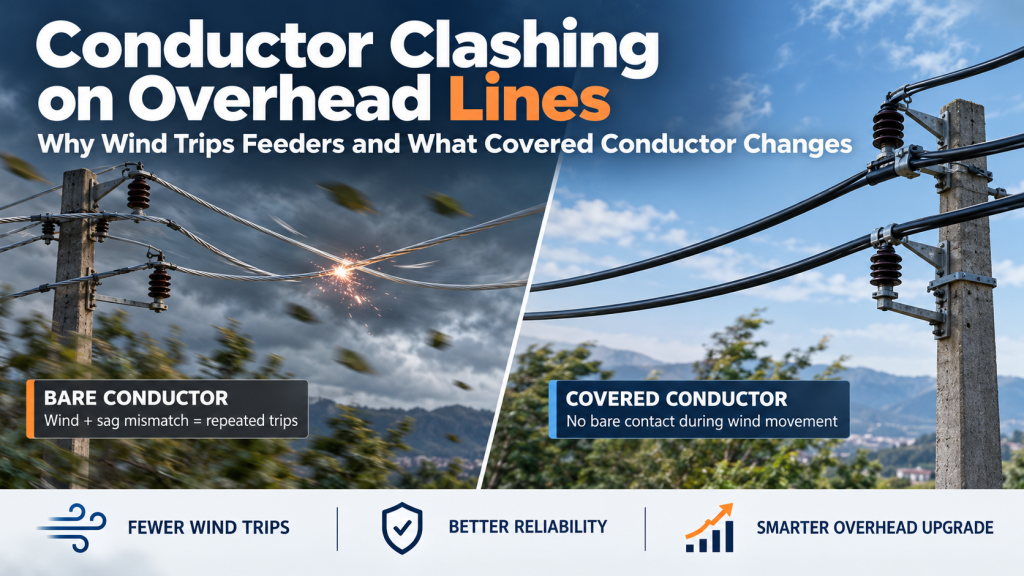
Conductor Clashing on Overhead Lines: Why Wind Trips Feeders and What Covered Conductor Changes
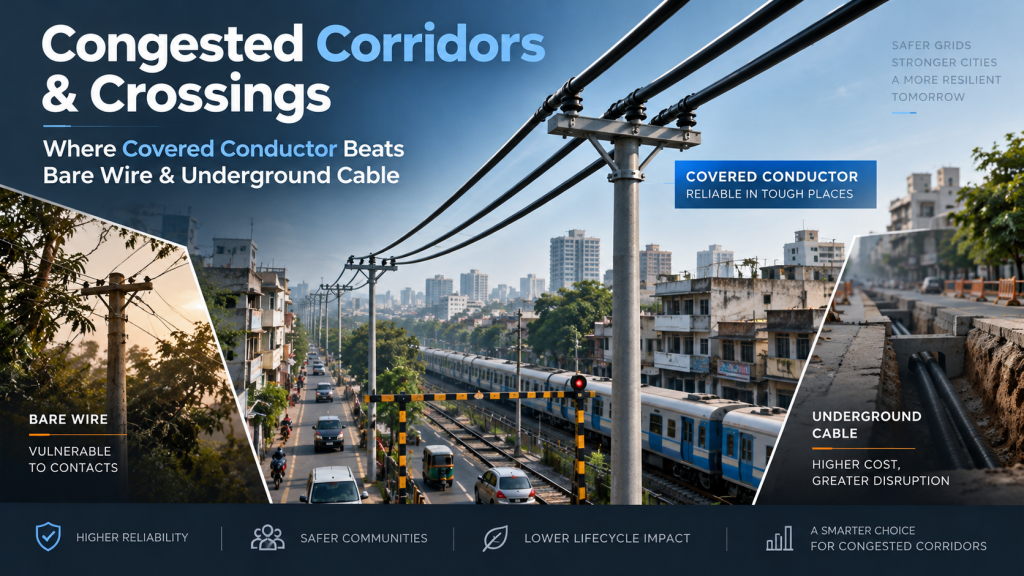
Congested Corridors and Crossings: Where Covered Conductor Beats Bare Wire and Underground Cable