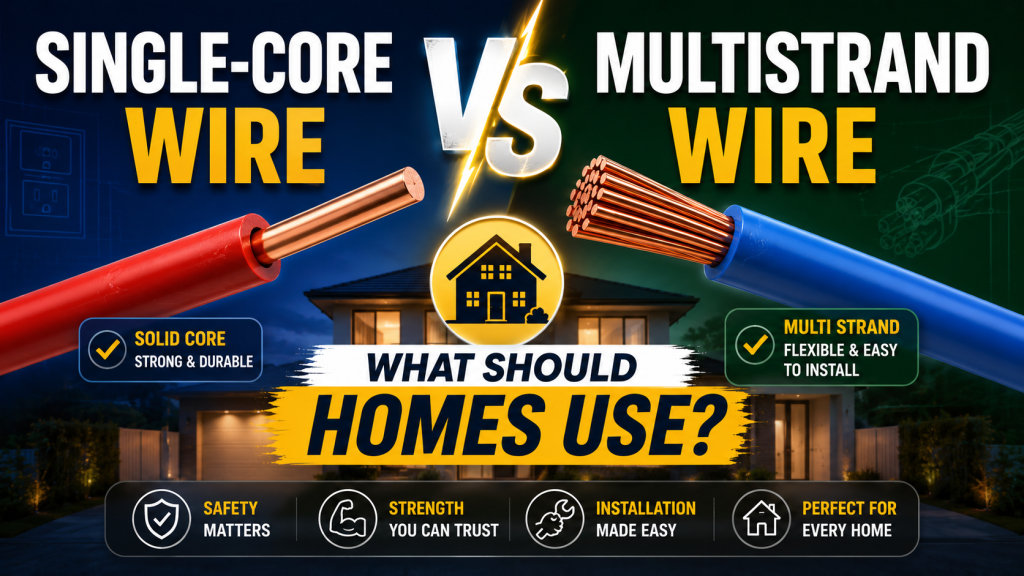
Copper or Aluminium? Where Each Conductor Actually Belongs
The copper against aluminium argument has outlived most of the people who started it. The physics has not moved. Aluminium’s resistivity is about 64% higher than copper’s, so an aluminium conductor needs roughly one size more to carry the same current. Almost everything sensible about choosing between the two follows from that single number, and from where the cable is going.
What makes the question worth revisiting is that the answer genuinely reverses partway up the size range. Below a certain point copper wins on every criterion that matters. Above it, aluminium wins on the only criterion that matters. Knowing roughly where the crossover sits saves a great deal of argument.
On this page
Inside a building, it is copper
Final circuits live in small conduits, land on accessory terminals designed around copper, and get disturbed every time somebody changes a switch or adds a socket. Those three facts settle the question before conductivity is even considered.
Copper is ductile, so it tolerates being bent into a terminal and bent back again. Its terminations stay stable: it does not creep away from a screw under thermal cycling in the way aluminium does, and it does not grow an insulating oxide layer the moment the surface is exposed. This is why Indian house wire is flexible class-5 electrolytic copper, and why every APAR house wire from Shakti FR to Anushakti Fire Protekt is built that way.
Below about 16 sq mm, aluminium is simply not worth the trouble. Small aluminium terminations age badly, and the size penalty buys nothing back because at those sizes the metal is a trivial part of the installed cost. The labour, the conduit and the accessories cost more than the conductor either way.
At feeder sizes, the argument reverses
Step up to distribution sizes and every one of those objections stops mattering, while a new factor takes over: weight.
Aluminium is around a third the weight of copper for the same volume. A 240 sq mm aluminium XLPE feeder weighs a fraction of its copper equivalent and costs far less. Go one size up and the resistance is bought back. Nothing has been lost except a little space in the tray.
Weight is not a convenience at this scale, it is the design constraint. It sets what a crew can pull in a shift, what a cable ladder has to be rated for, and on overhead lines it sets the sag, which sets the tower spacing, which sets the bill for the whole route. That is why utilities distribute on aluminium, why overhead conductors are aluminium outright, and why LV XLPE power cable is stocked in both metals up to 1000 sq mm.
The multicore case, where both appear
Multicore is where the two metals meet most often in ordinary work, because the same job description covers a two metre appliance tail and a two hundred metre pump run.
For appliance, motor and control wiring, copper is the default and for the same reasons as house wire. The cable is compact, the terminations are reliable, and it flexes without work-hardening. This is the territory of Shakti and, where continuous heavy load is involved, Mahashakti.
Aluminium multicore earns its place on long panel feeds and borewell pump runs, where distance makes copper extravagant and the terminations are few, accessible and made once by somebody who will torque them properly. Alumshakti Round covers the distribution runs and Alumshakti Flat is the usual submersible cable. The wider construction question, round against flat and how many cores, is covered in the multicore guide.
One rule applies to all of it and is broken constantly: size to the metal you actually chose. A 16 sq mm aluminium cable is not a substitute for a 16 sq mm copper one. Swapping metal without resizing is the single most common way an installation ends up running hot.
A working rule
Copper below 16 sq mm. Arithmetic above it.
Above the crossover, do the comparison properly rather than by instinct. Take the same load, size the aluminium one step up, and compare the installed cost including the larger gland, the larger tray and the extra termination care. Feeders usually land on aluminium once that sum is done honestly. Anything dense, flexible or frequently touched stays copper, whatever the arithmetic says, because the failure mode there is a loose joint rather than a warm cable.
Checking a datasheet is telling the truth
One habit is worth stealing from datasheet auditing work. When comparing brands, check the quoted aluminium resistance against IS 8130.
Printed datasheets have been found quoting copper-level resistance figures for small aluminium sizes, which is not a rounding error but a physical impossibility. Pure aluminium at 6 sq mm cannot beat 4.71 Ω/km. The honest values are 1.91 Ω/km at 16 sq mm and 1.20 at 25, and they are on the comparison table.
This is worth two minutes on any quotation. A datasheet that cannot get the physics right is not really telling you about the cable. It is telling you about the factory behind it, and about how much of what else is printed on it was checked.
Questions people ask
Is aluminium wiring unsafe?
Not inherently. It is unsafe when it is treated as a drop-in replacement for copper at the same size, or when small terminations are made without the right lugs and torque. On correctly sized feeders with properly made joints it has an excellent service record, which is why the entire distribution network runs on it.
How much bigger does aluminium need to be?
Roughly one standard size up for the same current, which follows from resistivity about 64% higher. Confirm against the rating tables rather than assuming, because the derating factors for the installation method apply on top.
Can copper and aluminium be mixed in one installation?
Yes, and most installations do: aluminium feeders into a board, copper final circuits out of it. What must not happen is copper and aluminium meeting at the same terminal without a bimetallic lug designed for it.
Which is better value overall?
It depends entirely on size. Below 16 sq mm the conductor is a small part of the installed cost and copper wins outright. On large feeders the metal dominates the cost and aluminium usually wins by a wide margin, even after sizing up.