Best House Wire in India (2026): How to Choose, Not Just Which Brand
Search for the best house wire in India and the results are mostly brand rankings. They are easy to read and close to useless when an electrician is standing in front of you saying “this one is fine, sir.” A brand name tells you who made the wire. It tells you nothing about what is inside the insulation, how it behaves in a fire, or whether it will still be safe in thirty years.
Wiring is the one part of a house that cannot be inspected after it is built. It sits inside the walls for the life of the building, and replacing it means breaking those walls. That is why it deserves more thought than the one to two per cent of the build cost it usually represents.
What follows is the six things a specifying engineer would actually check, and the numbers to insist on.
1. The conductor, where purity matters as much as size
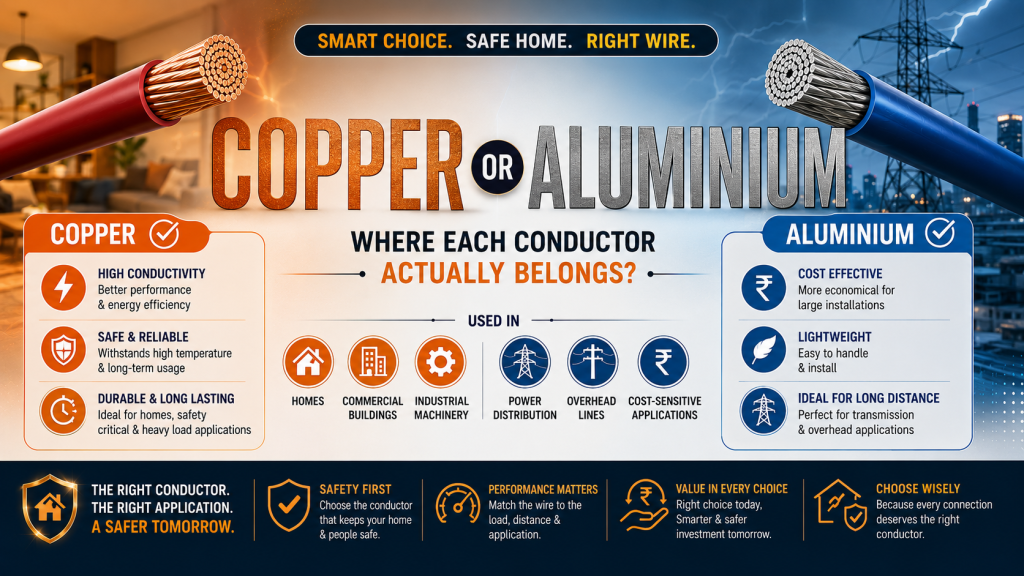
Every house wire carries current through a copper conductor, but not all copper is the same. The specification to look for is electrolytic-grade annealed bare copper at 99.97% purity. Higher purity means lower resistance, and lower resistance means less of the supply lost as heat every hour for the next three decades.
The number that proves it is conductor resistance in ohms per kilometre. IS 694:2010 sets the maximum permitted values: 12.1 Ω/km for 1.5 sq mm and 7.41 Ω/km for 2.5 sq mm in a Class 2 conductor. A wire quoting a figure at or below those is compliant. A wire that does not publish the figure at all has told you something without meaning to, because under-weight conductors, slightly less copper than the marked size, are one of the commonest ways cost is quietly removed from a product, and resistance is exactly where it shows.
2. The insulation grade
This single choice does more for fire safety than everything else in the wire combined.
- FR, flame retardant. Resists flame spread. The baseline.
- FR-LSH, flame retardant with low smoke and low halogen. Adds reduced smoke and acid gas.
- HR-FR-LSH. The above with a heat-resistant rating, usually 85 or 105 degrees.
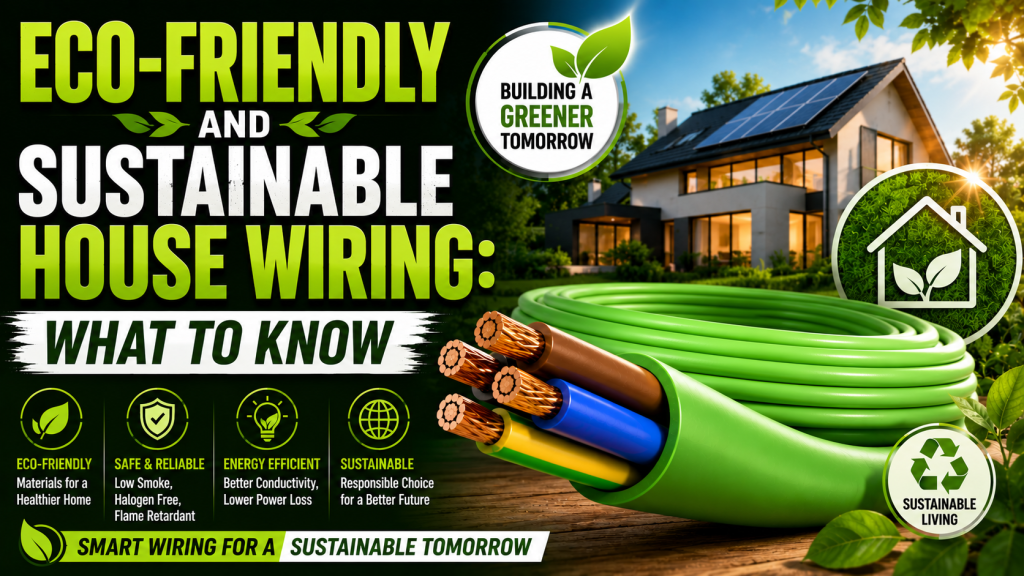
- HFFR, halogen-free flame retardant. The highest common domestic grade, releasing effectively no halogen gas.
The reason this dominates every other criterion is that most fatal house fires kill through smoke and toxic gas rather than flame. Wiring runs through every room, ceiling void and stairwell in a building, which are the same paths people use to get out. When PVC burns it releases hydrogen chloride: poisonous, and corrosive the moment it meets moisture, including the moisture in lungs. It also destroys electronics in rooms the fire never reached. In an enclosed stairwell that chemistry is the difference between escaping and not. The grade guide covers how to specify by risk rather than upgrading every circuit.
3. The standard the wire is genuinely certified to
Two Indian Standards govern domestic wiring and they are not interchangeable. IS 694:2010 covers PVC-insulated cables up to 1100 V, which means standard FR and FR-LSH house wire. IS 17048:2018 covers halogen-free flame retardant cable up to 1100 V, and BIS certification under it is mandatory.
So if a wire is sold as HFFR, ask which standard it is certified to. A genuine HFFR product references IS 17048. One that quotes only IS 694 is not what it is being sold as.
4. The four fire-performance numbers
These four appear on any serious manufacturer’s datasheet. When they are missing, that absence is itself the answer.
| Parameter | What it measures | What good looks like |
|---|---|---|
| Oxygen index | How much oxygen the air needs before the insulation will sustain a flame | 29% or above, 31% is strong |
| Temperature index | The temperature at which it will burn in normal air | 250 °C or above |
| Smoke density | How dense the smoke is, measured to IEC 61034 | Lower is better, around 10% is strong |
| Acid gas and halogen | Corrosive, toxic gas released while burning | Genuinely halogen free is 0.5% or below |
Air is roughly 21% oxygen, so an oxygen index above that means the material cannot keep burning once the ignition source is removed. It self-extinguishes. The temperature index matters in a developing fire, where the air around a cable gets hot long before flame arrives at it. Smoke density is the parameter most directly connected to whether people get out of a corridor, and it is the one most often left off a datasheet.
On halogen, be precise about the words, because they are easy to blur. Low halogen or LSH means reduced. Halogen free or HFFR means essentially none, tested at 0.5% or below, and certified under IS 17048. They are different products at different prices, and the labels sit next to each other on a shelf.
5. The ISI mark, and verifying it
The ISI mark indicates BIS certification. It should be printed along the wire itself rather than only on the drum or the packaging, and it should carry a licence number in the format CM/L-XXXXXXX.
Counterfeit wire is a real problem in India. Printing on the insulation is considerably harder to fake than a sticker on a box, which is precisely why reputable manufacturers do it. Read what is printed on the wire before it goes into the wall, because afterwards is too late. The label guide explains the rest of the printing.
6. Current-carrying capacity for the size actually needed
A wire’s rating depends on how it is installed. The same 2.5 sq mm wire carries a different safe load clipped to a surface, where it can shed heat, than it does buried in a conduit alongside five others. Good datasheets publish both figures, and the difference between them is not small.
As a rough domestic guide: 1.5 sq mm for lighting, 2.5 sq mm for general power points, 4 sq mm for a geyser or a small air conditioner, 6 sq mm for a larger unit or a vehicle charger. Size against the actual load and run length rather than against habit. The wire size calculator does the arithmetic.
How the APAR range compares
Rather than describe this in the abstract, here is APAR’s published fire-performance data across the range.
| Wire | Grade | Oxygen index | Smoke density | Acid gas | Temp rating |
|---|---|---|---|---|---|
| Shakti FR-PVC | FR | ≥ 29% | ≤ 60% | ≤ 20% | 70 °C |
| Shakti FR-LSH | FR-LSH | ≥ 29% | ≤ 60% | ≤ 20% | 70 °C |
| Green Wire HR-FR-LSH | HR-FR-LSH | ≥ 29% | ≤ 60% | ≤ 20% | 85 °C |
| Anushakti HR-FR-PVC | HR-FR-PVC | > 29% | 75% | 20% | 105 °C |
| Anushakti HR-FR-LSH | HR-FR-LSH | > 29% | 75% | 20% | 105 °C |
| Anushakti Fire Protekt EBXL | HFFR | ≥ 31% | ≤ 10% | ≤ 0.5% | 120 °C |
The pattern is worth reading slowly. Across the PVC-based grades the fire numbers are broadly similar, and what separates them is heat rating and features such as rodent resistance. The step change arrives with HFFR: smoke density falls to around 10%, and halogen to 0.5%. That is the difference between a corridor you can see through and one you cannot, and it is the entire reason the halogen-free grade exists.
Where the grade matters most
Fire-safety grade is worth paying for wherever evacuation is slow or crowded. High-rise flats, where the only route out is an enclosed stairwell. Hospitals, schools and anywhere with occupants who cannot leave under their own power. Basements, server rooms and data closets with no natural ventilation. Homes with elderly residents, small children, or a single exit.
So which is the best house wire in India?
The honest answer is that the best wire is the one whose manufacturer publishes all of the above and lets you verify it. Any manufacturer confident in its product will hand over a full datasheet with conductor resistance, the four fire-performance figures and the certification standard. One that offers adjectives instead is asking you to take its word for something you will never be able to check again once the plaster is on.
For most Indian homes being built today, an HR-FR-LSH or HFFR wire from a BIS-certified manufacturer, correctly sized, is the sensible specification. The price difference over basic PVC across a whole house is typically a few thousand rupees, set against a rewiring job costing lakhs and a fire risk that cannot be priced at all.
Every APAR house wire publishes its full specification, including conductor construction, resistance in Ω/km, fire-performance figures, applicable standards and current ratings for both conduit and clipped installation: Anushakti Fire Protekt EBXL HFFR, Anushakti HR-FR-LSH, Green Wire HR-FR-LSH and Shakti FR-LSH. Use them to judge APAR against any other manufacturer. If a competitor cannot supply the same figures, that is informative in itself.
Compare cables side by side, or read how to compare house wire brands without being misled.