The Role of Wires in Electrical Systems: A Comprehensive Guide
A wire carries electric current, or a signal, safely from one point to another. That is the entire job. Everything else about a wire, its metal, its thickness, the compound wrapped around it, exists to make that one job survive the conditions it will be asked to do it in.
Wire is the cheapest line on a wiring quotation and the most expensive thing on it to get wrong. A switch can be replaced in ten minutes. A cable specified badly sits behind plaster for thirty years, and the first sign it was the wrong choice is usually heat, a breaker that trips for no visible reason, or smoke. This guide covers what a wire does, how a wire differs from a cable, the main types in use in India, and how the choice is made.
In this guide
What a wire actually does
A wire is a strand, or a bundle of strands, of a highly conductive metal that lets current flow along it. Its function is conduction: offering a path of low enough resistance that electricity reaches the point of use without losing a meaningful share of itself as heat on the way.
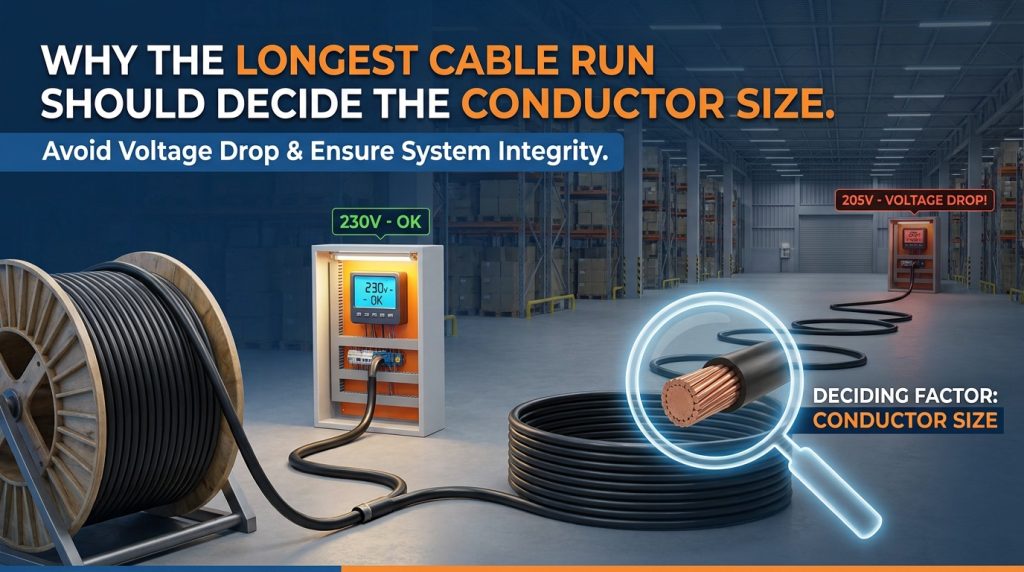
No conductor is perfect, and the loss is not academic. Every metre of undersized cable turns part of the supply into warmth inside a wall, drops the voltage reaching the appliance, and shortens the life of the insulation against it. Correctly sized wire runs cool and is forgotten. Undersized wire announces itself eventually. The wire size calculator gives a starting size for a domestic circuit.
Wire or cable: the distinction that matters
The two words get used interchangeably on site. In conversation that is harmless. In a specification it is not.
A wire is a single conductor. It may be one solid strand or many fine strands twisted together, but electrically it is one path, with insulation over it. House wiring pulled through conduit is wire.
A cable is two or more insulated conductors bundled inside a common outer sheath. That sheath is the point. It holds the cores in a fixed geometry, which matters for interference and for handling, and it takes the abrasion, moisture and mechanical punishment that would otherwise reach the insulation. A cable can therefore be laid where a wire cannot: buried, run outdoors, dragged across a factory floor, taken down a borehole.
The practical consequence is simple. Circuits inside a building are wired with single-core wire in conduit, because the conduit is doing the protecting. The moment the run leaves that protection, or needs to carry several separate conductors to one destination, it becomes a cable. This is also why an appliance flex is a cable and not a wire, and why the question comes up constantly in the middle of quotations.
What wires do across a whole system
Individually a wire connects two points. Together, the wiring in a building performs three jobs worth separating, because each is governed by different rules.
Carrying power. Mains current from the board to lights, sockets, appliances and machinery. This is the work of house wire and power cable, and it is governed by current-carrying capacity, voltage drop and fire performance.
Carrying signals. Data, video, audio and control information, where the value is not power delivered but information preserved. This is the work of communication cable, and the governing concerns are bandwidth, attenuation over distance and interference.
Interconnection. Joining components so the system behaves as one, from a distribution board down to a terminal block inside a control panel. The constraints here are mechanical and practical: flexibility, termination, and being able to identify a core two years later.
The main types, and what each is for
Cable types multiply endlessly, but almost everything encountered in an Indian building or plant belongs to one of these families.
| Type | What it is | Where it is used |
|---|---|---|
| Single-core house wire | One insulated conductor, usually stranded copper | Building circuits in conduit, to IS 694 |
| Multicore cable | Several insulated cores under one sheath, round or flat | Appliances, motors, submersible pumps, panel wiring |
| Power cable | Heavy conductors, often armoured, XLPE or PVC insulated | Distribution from substation to board, buried or in tray |
| Coaxial cable | Centre conductor inside a concentric screen | CCTV, cable television, broadband, RF feeds |
| Data and LAN cable | Twisted pairs, screened or unscreened | Networking, structured cabling, IP cameras |
| Screened control cable | Cores plus a screen taken to earth at one end | Instrumentation, 4-20 mA loops, automation |
| Elastomer and flexible cable | Rubber compounds that tolerate repeated bending | Cranes, welding sets, mining, festoon systems |
| Fire-performance wire | Flame-retardant, low-smoke or halogen-free compounds | High-rises, hospitals, schools, public buildings |
The families overlap at the edges. A screened multicore is both a multicore and a control cable. What decides the choice is rarely the family name, it is the four questions in the last section.
What wires are made of
Two decisions sit inside every cable: what the conductor is, and what is wrapped around it.
Copper is the default conductor and deserves to be. It carries roughly two thirds more current for a given cross-section than aluminium, takes repeated flexing without work-hardening, and terminates reliably. Aluminium is lighter and cheaper per unit of current delivered, which is why it dominates overhead lines and large distribution sizes, but it needs about 1.6 times the cross-section for the same resistance and it is unforgiving at terminations. The full comparison is here. For house wiring in India the answer is copper, and the question is only what size.
The insulation is the part that decides how the cable behaves when conditions turn. Ordinary PVC is rated to 70 degrees at the conductor. Cross-linked polyethylene reaches 90. Halogen-free compounds such as HFFR give up a little on cost to produce almost no smoke and no acid gas in a fire. Some insulation is cross-linked by electron beam processing rather than chemically, which lifts the temperature rating further and toughens a thin wall. The insulation types are covered in detail separately.
Carrying current safely
Three things decide whether a cable is safe in service, and all three have to be right.
Conductor size. A larger cross-section carries more current and drops less voltage over distance. Size to the load and to the length of the run, not to what the last job used. Conductor resistance is capped by IS 8130, which is the number worth checking on a datasheet because it reveals how much copper is genuinely present.
Insulation grade. The grade sets the temperature the conductor may reach, and therefore the current allowed. It also sets what happens in a fire. In stairwells, basements and anywhere people have to walk out past the cable, a low-smoke HR-FR-LSH grade is worth the difference in price.
Protection. The breaker protects the cable, not the appliance. Fitting a larger MCB because a circuit keeps tripping removes the only thing standing between an overloaded cable and a fire. The MCB to wire size chart gives the pairings.
Choosing the right wire
Four questions, in this order, settle almost every domestic and light commercial choice.
What is the load, and how far does it travel? Those two set the conductor size. What is the environment: how hot, how wet, how exposed to abrasion? That sets whether a wire in conduit is adequate or a sheathed cable is required. Who occupies the building, and how quickly can they leave it? That sets the fire grade. And is this power or signal? That decides the family before anything else does.
For a home or a small commercial fit-out, size the circuits with the wire size calculator, then choose the grade from the house wire range. Have the final design confirmed by a licensed electrician, who is the person carrying the responsibility for it.
Questions people ask
What is the function of a wire in a circuit?
To provide a low-resistance path so current flows from the supply to the load and back, delivering power without the conductor overheating or the voltage sagging on the way.
What is the difference between a wire and a cable?
A wire is a single conductor. A cable is two or more insulated conductors bundled under a common sheath, which protects them and lets the assembly go places a bare wire cannot.
What are wires usually made of?
Copper in almost all building wiring, for conductivity and durability. Aluminium in larger distribution sizes where weight and cost dominate. The insulation is PVC, cross-linked polyethylene, or a halogen-free compound where smoke matters.
Does a thicker wire always mean a better job?
No. Oversizing wastes copper and makes terminations awkward without improving safety, because the breaker still has to match the cable. The correct size is the one that carries the load with acceptable voltage drop, and no more.