FR, FRLS, or HFFR Wire: Which One Should Be Behind Your Walls?
FR, FRLS and HFFR are the three fire-safety grades of house wire sold in India, and the letters on the coil decide how a fire behaves inside a wall. FR slows the flame. FRLS slows the flame and cuts the smoke. HFFR does both and releases almost no corrosive gas while doing it.
That is the short answer. The longer one matters because the price gap between the three grades is small, the difference in what happens during the ten minutes people need to get out is not, and the decision is made once and then buried in plaster for thirty years.
On this page
What the three grades actually mean
All three describe how the insulation behaves when it meets fire, and how much collateral harm it causes while behaving that way.
FR, flame retardant
FR insulation is self-extinguishing. Remove the ignition source and the fire does not sustain itself along the wire. APAR’s FR compound runs an Oxygen Index above 29% and a Temperature Index above 250 °C. For moderate loads in ventilated spaces this is a sound baseline, and Shakti FR-PVC is the grade for it.
FRLS, flame retardant and low smoke
FRLS resists flame in the same way but emits considerably less smoke and fewer toxic gases while it burns. This is the grade that acknowledges an uncomfortable fact: in most house fires, people are overcome by smoke long before flame reaches them. Shakti FR-LSH and the heat-resistant Green Wire HR-FR-LSH sit here.
HFFR, halogen free flame retardant
HFFR removes the halogens from the compound entirely. Under fire it gives off acid gas of around 0.5% against roughly 20% for a standard FR wire, and smoke density of around 10% against 60 to 75%. Those two numbers are the whole argument for the grade. Anushakti Fire Protekt EBXL HFFR is the APAR product.
The three grades side by side
| Property | FR | FRLS | HFFR |
|---|---|---|---|
| Resists flame spread | Yes | Yes | Yes |
| Smoke when burning | High, 60 to 75% | Reduced | Very low, around 10% |
| Corrosive acid gas | Around 20% | Lower | Around 0.5%, halogen free |
| Suited to | Ventilated areas, moderate loads | Bedrooms, living rooms, kitchens | High-rises, enclosed spaces, public buildings |
FR-PVC against HR-FR-LSH, the everyday choice
Most Indian buyers are not choosing between all three grades. They are standing in front of two coils: an economical FR-PVC wire and an HR-FR-LSH wire that costs a little more.
FR-PVC is a genuinely adequate product. It is flame retardant, it self-extinguishes, and it has wired a very large number of buildings that have never had a problem. Nothing about choosing it is negligent.
HR-FR-LSH adds two things. The HR is heat resistance, a higher permitted operating temperature, which matters because the loads in an Indian home today are not the loads the wiring rules were written around. Air conditioning, induction cooking, geysers and now vehicle charging all run for hours rather than minutes. The LSH is the low smoke and low halogen behaviour described above.
The honest way to frame the decision is this. On a circuit running lights in a ventilated room, FR-PVC is fine. On the circuits that carry heavy continuous load, and on every circuit in a room where somebody sleeps, the extra cost of HR-FR-LSH is small measured against the thirty years it sits there. Wiring is typically one to two per cent of the cost of building a house. The grade upgrade is a fraction of that.
Where each grade belongs in a home
A sensible domestic specification is rarely a single grade throughout. It is graded by risk.
Lighting and light-load circuits in ventilated rooms can sit on FR. Bedrooms, living rooms and kitchens are better on FRLS or HR-FR-LSH, because these are the rooms people are in when a fire starts at night. Heavy appliance circuits, the air conditioner, the geyser, the vehicle charge point, want the heat-resistant grade whatever else is chosen, because those are the runs that spend hours warm. Anything passing through an enclosed shaft or a common stairwell should be halogen free, since that is the route out of the building.
Tall buildings, hospitals and schools
Above a certain height and a certain density of occupancy, the wiring specification stops being an electrical decision and becomes a life-safety one.
In a high-rise, evacuation takes minutes, not seconds. People move down stairwells that are also service routes, and the behaviour of the cable in those shafts decides how survivable that descent is. Ordinary PVC produces dense black smoke and hydrogen chloride gas, which turns corrosive on contact with moisture, including the moisture in lungs. Halogen-free cable produces very little of either.
The same reasoning applies with more force in buildings whose occupants cannot leave quickly. Hospitals have patients who cannot walk. Schools have children who need directing. Airports and malls have crowds who do not know the exits. In all of them, smoke that blocks visibility harms people long before flame arrives, and the acid gas that comes with it also corrodes exactly the equipment these buildings depend on.
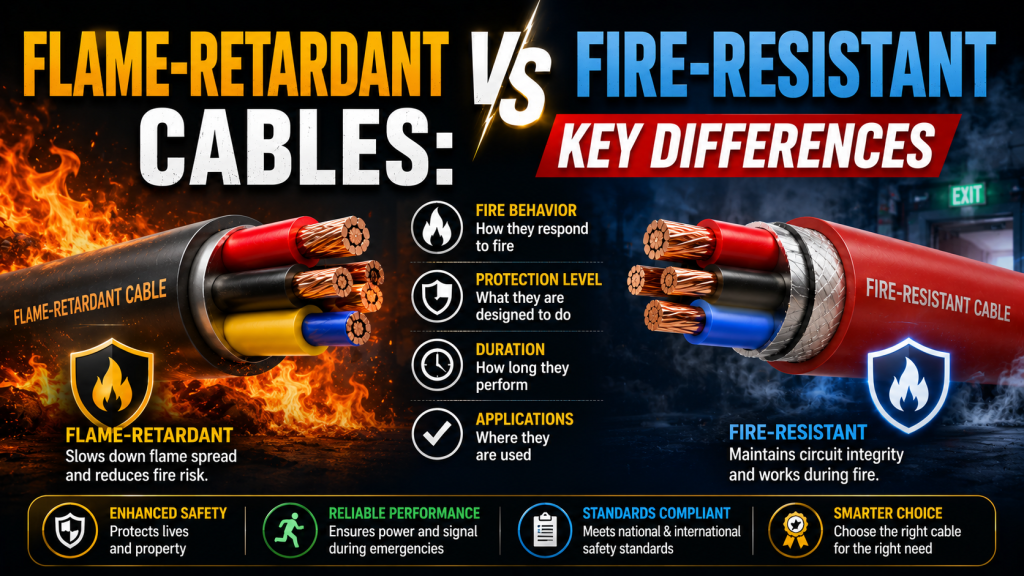
A specification for these buildings normally uses two different cable types together, and they are often confused. General power and lighting circuits take HR-FR-LSH or HFFR grades, so that a fault anywhere produces minimal smoke. Life-safety circuits, meaning fire alarms, emergency lighting, lifts and fire pumps, need fire-resistant cable, which is a different specification: cable that keeps carrying current while it is burning. Flame retardant and fire resistant are not synonyms, and the distinction belongs in the specification rather than in the argument afterwards. The National Building Code and the local fire regulations for the occupancy type govern both.
Why the e-beam difference matters
Two wires can both be described as HFFR and behave differently, because the compound can be cross-linked or not.
Electron beam processing passes the finished wire under a beam of high-energy electrons, which ties the polymer chains together after extrusion. The insulation stops being a thermoplastic that softens and starts being a thermoset that chars in place. It tolerates a higher operating temperature, resists cuts and abrasion during the pull, and does not deform where a hot conductor presses against it inside a crowded conduit. Combining that process with a halogen-free compound is what produces the top grade.
Choosing
Work down this list and the grade selects itself. How heavy and how continuous is the load on this circuit? How enclosed is the space the cable runs through? Who is in the building, and how long would it take them to get out? Is this a life-safety circuit that has to keep working, rather than merely fail safely?
Then verify what you are buying. The grade is printed on the wire, but so is a great deal of marketing. Ask for the four fire-performance numbers: oxygen index, temperature index, smoke density and halogen content. A manufacturer that tests its compound publishes them. The wire label guide explains what the rest of the printing means, and the buyer’s guide covers the purchasing side. The full house wire range lists the grades against products.
Questions people ask
Is HFFR worth the extra cost in an ordinary flat?
On the circuits in bedrooms and on anything running through an enclosed shaft, yes. The difference over a whole flat is usually a few thousand rupees, against wiring that stays in place for decades.
Does FR wire mean the wire cannot burn?
No. It means the insulation will not sustain a flame once the ignition source is removed. Under a sustained external fire, FR insulation still burns, and produces smoke and acid gas while it does.
What is the difference between FRLS and HFFR?
FRLS reduces smoke and toxic gas. HFFR removes the halogens that produce the corrosive gas in the first place, so the reduction is far larger rather than incremental.
Can different grades be mixed in one house?
Yes, and it is usually the sensible approach. Specify by risk: the better grade where load is heavy, where the space is enclosed, and where people sleep.