What Is E-Beam Technology in Wires and Cables?
Electron beam processing is a manufacturing step, not a material. A finished wire passes under a controlled stream of high-energy electrons, and those electrons tie the polymer chains of the insulation to one another. The compound that goes in is ordinary. The compound that comes out behaves like a different class of material.
APAR was the first Indian manufacturer to commercialise the process at scale, and it is the technology behind the company’s most advanced fire-safe house wires. What follows is what the process actually changes, where the difference shows up in a building, and where it does not justify the cost.
On this page
What cross-linking actually does
Ordinary wire insulation is extruded: heated, shaped around the conductor, cooled. The polymer chains inside it stay loose and independent. That is what makes the material a thermoplastic, and it has one consequence that matters more than all the others. Heat it enough and it softens. Heat it further and it flows.
Cross-linking bonds those chains into a three-dimensional network. The material stops being a thermoplastic and starts behaving like a thermoset. It no longer has a melting point in any useful sense. Under enough heat it chars in place instead of softening, dripping, or fusing itself to the core lying next to it inside a conduit.
Three practical things follow. The permitted operating temperature rises substantially: where ordinary PVC is limited to 70 degrees at the conductor, cross-linked compounds sit in the 105 to 125 degree region, and they ride out the couple of seconds of a short circuit at around 250 degrees rather than 160. The insulation gets physically harder, so it resists the abrasion of being dragged through a conduit and the nick from a careless stripping blade. And because the material is stronger, the wall can be thinner for the same protection, which makes the finished wire easier to pull and to terminate.
Why a beam rather than chemistry
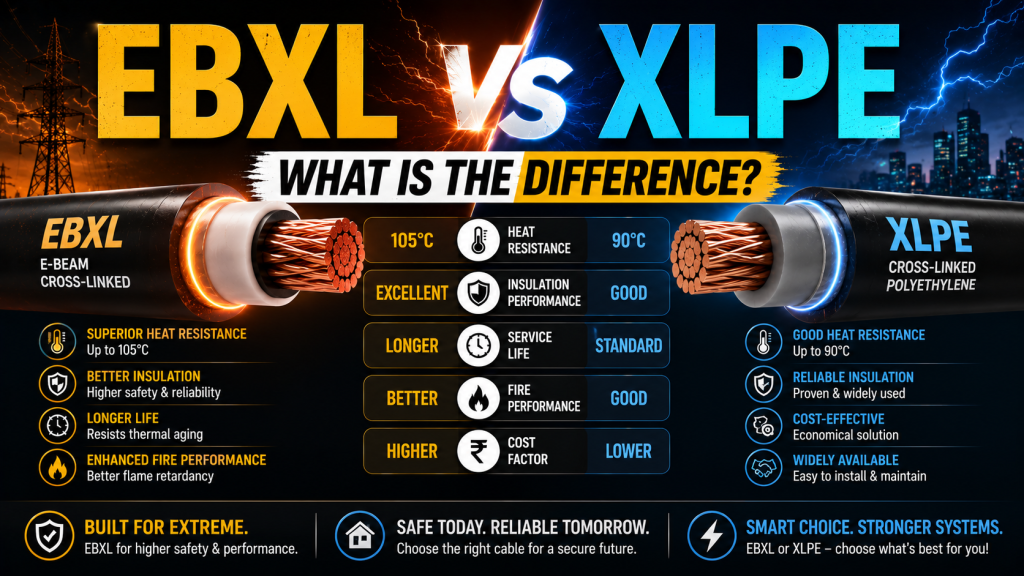
Polymers can also be cross-linked chemically, using peroxides and heat, which is how most XLPE power cable is made. Electron beam processing reaches the same end by a different route, and the differences are practical rather than theoretical.
The beam is applied after extrusion, at room temperature, to a wire that is already finished. Nothing has to be held at temperature in a curing tube. The dose is measured and controlled, so the degree of cross-linking is a setting rather than a consequence of line speed. And because no chemical initiator is involved, nothing is left behind in the compound to migrate out over the following decades.
The trade is capital. An electron beam accelerator is an expensive machine and it has to be shielded, which is why relatively few cable plants have one. The full comparison between the two routes is in EBXL against XLPE, and the process itself is described on the e-beam technology page.
Against a conventional PVC wire
| Property | Conventional PVC wire | E-beam cross-linked wire |
|---|---|---|
| Insulation type | Thermoplastic | Cross-linked, behaves as a thermoset |
| Behaviour under heat | Softens, can melt and drip | Does not melt, chars in place |
| Conductor temperature | 70 °C | 105 to 125 °C class |
| Short circuit | Around 160 °C | Around 250 °C |
| Mechanical strength | Standard | Harder, better abrasion resistance |
| Smoke and halogen in a fire | Smoke and acid gas, reduced in LSH grades | With an HFFR compound, very low smoke, halogen free |
| Cost | Lower | Premium |
The row that matters most is the second one. A flame-retardant PVC wire is still a thermoplastic underneath. FR and FR-LSH grades change how the compound behaves in a fire, which is worth having, but they do not change what happens when a conductor simply runs hot for years inside a crowded conduit. That is where softening, deformation and core-to-core contact begin, and it is a slow failure nobody sees.
Is it worth it in a home
Honestly, not on every circuit. A lighting circuit in a ventilated room is not asking anything difficult of its insulation, and a good FR or FR-LSH wire will do that job for the life of the building.
The argument gets much stronger in three situations. The first is heavy continuous load. The electrical demand of an Indian home has changed: air conditioning, geysers, induction cooking, home offices and now vehicle charging all draw current for hours rather than minutes, and it is sustained heat, not peak current, that ages insulation. The second is concealed wiring that will not realistically be replaced, where the cost of getting it wrong is breaking walls rather than swapping a cable. The third is any circuit passing through an enclosed shaft or an escape route, where combining cross-linking with a halogen-free compound means the wire neither melts nor fills the stairwell with smoke.
Put crudely, wiring is one to two per cent of the cost of building a house, and the grade upgrade is a fraction of that, against thirty years of service. The grade guide sets out how to specify by risk rather than upgrading everything, and the wire size calculator handles the sizing.
Where it appears in the range
Anushakti Fire Protekt EBXL HFFR is the wire that combines both technologies: electron beam cross-linking applied to a halogen-free, low-smoke compound. It is the top of the house wire range and the specification for high-rises, enclosed spaces and buildings whose occupants cannot leave quickly.
Anushakti Fire HR-FR-PVC and Anushakti HR-FR-LSH sit below it, adding heat resistance to flame-retardant compounds. Shakti FR-PVC is the conventional flame-retardant baseline. The full house wire range lists grades against products, and the underlying materials are covered in the guide to insulation types.
Questions people ask
Does e-beam wire really not melt?
Correct, in the sense that matters. Cross-linking removes the melt transition, so the insulation cannot soften and flow away from the conductor. Under a sustained external fire it will eventually char and be destroyed, but it will not drip or fuse to its neighbours on the way there.
Is e-beam the same as XLPE?
Both are cross-linked, and the end behaviour is similar. The difference is how the cross-linking is achieved: a beam of electrons after extrusion, against peroxide and heat during it.
Does cross-linking make a wire fire resistant?
No, and the distinction matters. Cross-linking is about heat and mechanical behaviour. Fire performance comes from the compound: whether it is flame retardant, low smoke, or halogen free. A wire can be cross-linked and still produce a great deal of smoke if the compound is ordinary PVC.
Can e-beam wire be used with normal fittings?
Yes. The conductor is the same flexible electrolytic copper, sized the same way, and it terminates into standard accessories. The thinner, harder wall usually makes it easier to work with rather than harder.
Related
EBXL vs XLPE: What Is the Difference?
Conductor Clashing on Overhead Lines: Why Wind Trips Feeders and What Covered Conductor Changes