How to Read an Electrician’s Wiring Quote: The Wire Line That Decides What Is Behind Your Walls
Once the plaster is back on the wall, the wiring cannot be inspected, tested or changed without breaking the wall again. The only record of what went in is the electrician’s quotation. Yet the wire line on many quotations reads something like “FRLS wire, 1.5 and 2.5 sq mm, good brand”, which says almost nothing a homeowner can check.
This article explains what the wire line of a quotation should contain, why each item matters, and what to ask for before the work is approved.
What a vague wire line hides
“FRLS” is shorthand that shops and contractors use loosely. Behind it sit several different products. In the APAR range the grades are FR-PVC, FR-LSH, HR-FR-LSH and HFFR. They differ in how they behave when heated or burnt, and they differ in price. A quotation that names none of them lets the cheapest grade be supplied under the same words.
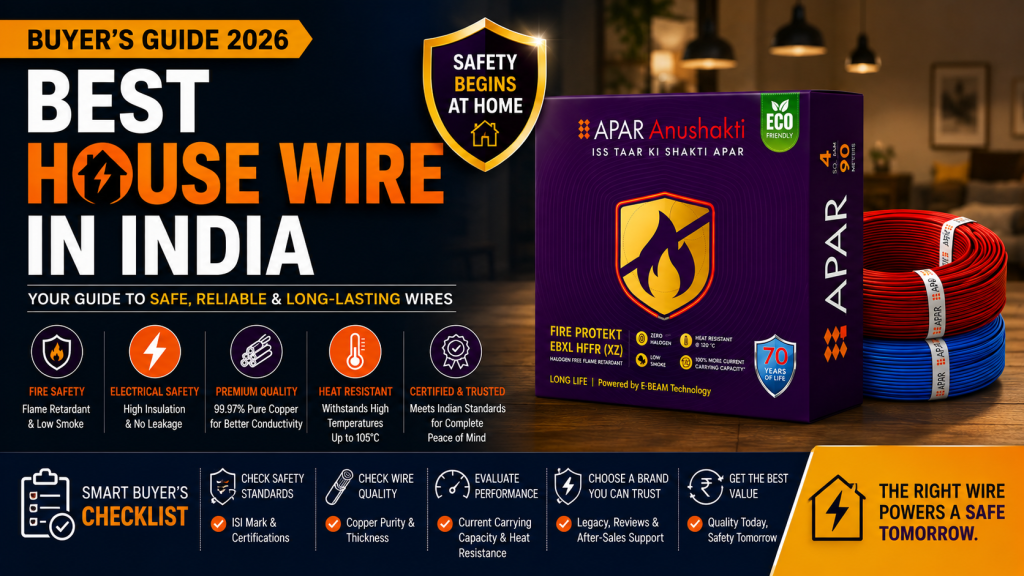
Two terms are worth knowing. LSH means low smoke, low halogen. HFFR means halogen-free, flame-retardant, and it is a separate and higher grade. Low halogen and halogen-free are not the same claim. On the APAR range, halogen-free insulation is offered as Anushakti Fire Protekt EBXL HFFR.
Five things the wire line should state
- The product name and grade, for example Shakti FR-LSH or Anushakti HR-FR-LSH, not just “FRLS”.
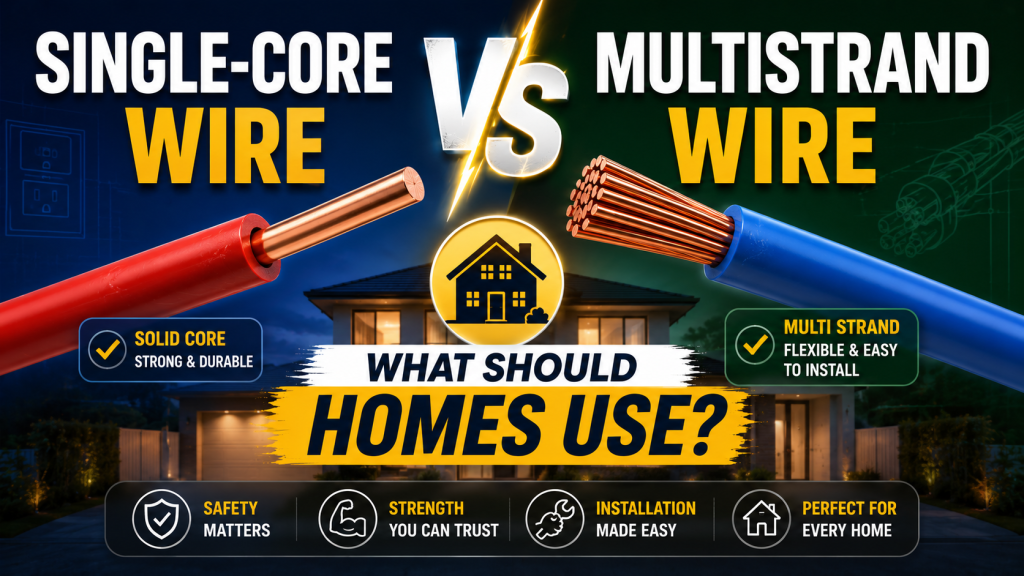
- The sizes for each circuit, in square millimetres. Sizes follow the load, so a lighting circuit and an air conditioner circuit will not use the same wire.
- The quantity, with the coil length written out, so that the quantity bought can be matched to the quantity delivered.
- The standard and marking: IS 694:2010, with the ISI mark and the BIS licence number. The APAR product pages state that grade, size, 1100 V, IS 694 and the BIS licence number are printed along the wire itself.
- A statement that the datasheet will be supplied on request. A manufacturer that publishes specifications has nothing to hide, and a datasheet turns a brand name into numbers.
If any of these is missing, ask for it to be added in writing. A reputable contractor will not mind. It is also a fair test of how the rest of the job will be run.
Where the grade matters most in a home
The grade is worth paying attention to in a few places. These are examples drawn from what the APAR product pages state, and the product page for each wire should be checked for the current wording.
Warm areas, such as a kitchen near the hob, the space above a top-floor ceiling or the inside of a distribution board, ask more of insulation. Anushakti HR-FR-LSH and Anushakti HR-FR-PVC are listed for operation up to 105°C. A wire should still be kept away from hot surfaces, whatever its rating.
Ground floors, store rooms and homes near open land can suffer from termites and rodents. The Green Wire page lists rodent-resistant insulation, and the Anushakti pages list termite protection. Pest-resistant insulation does not replace conduit, which should still be used.
In apartment towers, where escape routes are long and smoke is the main danger, the halogen-free option is the one to discuss. Fire Protekt lists residential towers, hospitals and schools among its applications. The standard FR-LSH option is Shakti FR-LSH.
Comparing two quotations fairly
Two quotations for the same house can differ by a large amount in the wire line alone. Before comparing the totals, compare the lines. Are the grades the same? Are the sizes the same for each circuit? Is the coil length the same? Is the conductor stated as copper, and is the product named? A lower total that comes with an unnamed grade is not a saving. It is a different product at a different price, and the quotation does not say which.
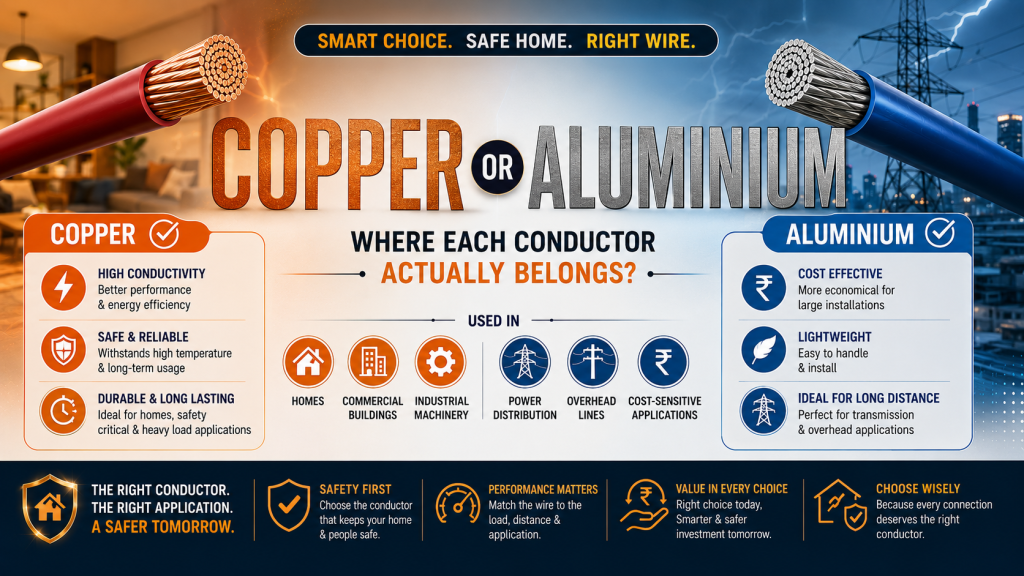
Conductor material is the quietest difference. Every APAR house wire listed on its product page is a copper-conductor wire, and the Green Wire page states 99.97% electrolytic copper. A quotation that says only “wire” does not tell the homeowner whether the conductor is copper at all. Ask for the word to be written in.
It is also reasonable to ask for the same wire line on both quotations. If one electrician names a product and the other will not, the homeowner has learnt something about both of them without opening a coil.
Questions to put to the electrician
Short, specific questions work better than general ones. Which exact product is in the quotation, and which grade is it? Which sizes are used for which circuits, and why? Does the quantity allow for the full length of each run, including bends and drops? Will the unopened coils be shown before use, so the printed marking can be compared with the quotation? Can the datasheet be provided?
The size question is the one most often answered with habit rather than reasoning. The wire size for home appliances chart gives a starting point for common loads, and the final design should be confirmed by a licensed electrician.
Checking the wire when it arrives
When the coils arrive, read the print along the wire. It should match the grade and size in the quotation. If the print shows a different grade, or no BIS licence number, stop and ask before any wire goes into a conduit. The house-wire buying checklist sets out the full list of checks.
It also helps to photograph the printed wire on each coil, and to keep the photographs with the quotation and the final invoice. Years later, when an extra circuit is added or a fault is traced, that record shows exactly what is behind the wall.
APAR recommends that the product name and grade go into the quotation, in writing, before the job begins. A few extra lines on a quotation cost nothing, and they are the only record of what is inside the walls once the work is finished.