A Simple Wiring Guide for New Homeowners in India
Most people buying or building a home in India spend weeks choosing tiles and days choosing paint, and leave the wiring entirely to the contractor. It is an understandable order of priorities. Finishes are visible and wiring is not.
It is also the wrong way round in terms of consequence. Everything visible can be changed later at moderate cost. The wiring works continuously behind the plaster for the life of the building, decides whether the house can take an extra air conditioner or a vehicle charger in five years, and cannot be replaced without breaking the walls it sits inside. This guide covers what a first-time homeowner needs to understand, what a builder’s “standard wiring” actually means, and the five questions worth asking before the walls close.
The basics, without an engineering degree
Three things describe any house wire, and they are enough to hold a useful conversation.
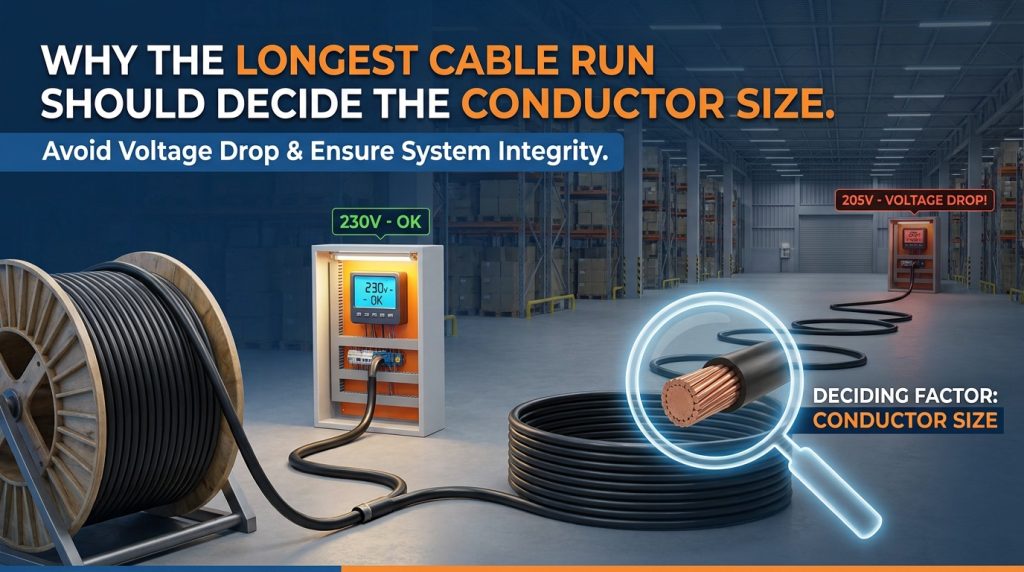
Size, in square millimetres. This is the cross-section of the copper, and it sets how much current the wire can carry without overheating. Undersized wire runs hot, wastes energy as heat every hour it is loaded, and ages its own insulation. The wire size calculator gives a sensible starting figure per circuit.
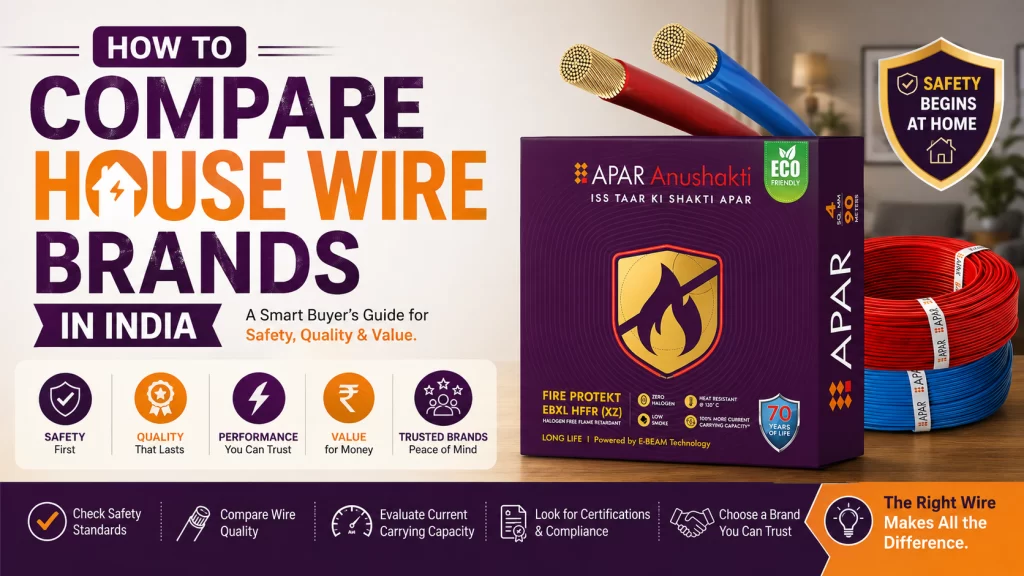
Grade, meaning the insulation. FR, FR-LSH, HR-FR-LSH and HFFR describe how the wire behaves in heat and in a fire. This choice does more for safety than anything else in the specification, and the grade guide explains which belongs where.
Standard and marking. The ISI mark with a BIS licence number should be printed along the wire itself, not only on the drum. IS 694:2010 governs PVC house wire, IS 17048:2018 governs genuine halogen-free wire. The label guide covers the rest of the printing.
Before work starts, ask for the brand, size and grade to be written down for each group of circuits: lighting, general sockets, kitchen, air conditioning, and heavy appliances. That single list makes every later conversation easier.
What “standard wiring” actually means
In a new project brochure, “standard wiring” appears as one line item and reads like a complete specification. In practice it usually means the least expensive IS 694 compliant FR PVC wire the developer could source, sized for an average load today and nothing beyond it.
Typically that means 1.0 to 2.5 sq mm copper across general circuits, little differentiation between low-load and high-load zones, basic FR grade rather than FR-LSH or HFFR, conventional PVC rather than cross-linked insulation, and no allowance at all for loads that do not exist yet.
It meets code. That is genuinely worth something and it is not a scandal. But meeting code and matching the realistic load profile of an Indian household over the next twenty-five years are different tests, and builder-grade wiring is designed against the first one.
What that costs later
The gap shows up in four places, none of them on handover day.
Running cost. Lower conductor purity and thinner cross-sections mean higher resistance. Resistance becomes heat, and heat is energy that was paid for and not used. It is a small percentage on every circuit, every hour, for decades. Premium wires such as Green Wire HR-FR-LSH use 99.97% pure electrolytic copper for exactly this reason.
Appliance life. Sustained heat in an undersized circuit shortens the life of everything on it. Air conditioners, refrigerators and inverters all run hotter than they were designed to and fail earlier than they should.
No headroom. Adding a vehicle charger, a second air conditioner or an induction hob to wiring that had no spare capacity means retrofitting through finished interiors. That runs into lakhs. Specifying the better wire at construction stage costs a few thousand rupees per circuit.
Fire behaviour. Basic FR wire slows flame but still produces dense smoke and corrosive gas as it burns. In an enclosed stairwell or a bedroom at night, that is the part that matters.
The five checks worth insisting on
1. Ask to see the wire and the box
Electricians are routinely pressured to install cheaper wire than the one being billed. Ask to see sealed coils before installation, photograph the label, and make sure one consistent brand runs across the critical circuits. Counterfeit and substandard wire is a real problem in the Indian market, and printing on the insulation is far harder to fake than a sticker on packaging.
2. Ask for wire size against each heavy circuit
Air conditioners, geysers, ovens, kitchens and charge points need thicker wire and dedicated lines. Ask for a simple list mapping each appliance to its wire size, and confirm that heavy appliances are not sharing a single common line. This one list catches most sizing shortcuts.
3. Ask whether the wire is low smoke
In an electrical fire the smoke does more harm than the flame, and it does it first. Ask directly whether the wire is FR-LSH or HFFR, and insist on it in bedrooms, corridors, children’s rooms and anything that forms an escape path. Anushakti Fire Protekt is the halogen-free grade in the APAR range.
4. Ask what the plan assumes about future load
Most homes are wired for the day they are handed over. Plan spare capacity for additional air conditioning, a home office, and parking-area provision for a vehicle charger. Make sure there are proper outlets near television units, study corners and routers. A house that ends up permanently relying on extension cords was not wired for how it is actually lived in.
5. Ask what testing happens before handover
Switching on a few lights is not testing. Ask for insulation resistance and continuity testing with proper instruments, and request the readings in writing. Refuse twisted joints, taped repairs and hidden temporary connections. Ask for a circuit schedule, meaning a list of which breaker controls what, because in ten years that document is worth more than anyone expects.
Where the better grades genuinely earn their cost
Not every circuit needs the top grade, and specifying one wire throughout the house is usually paying for capability that will never be used. The sensible approach is to grade by risk.
Lighting in ventilated rooms can sit on a good FR wire. Bedrooms and living spaces are better on a low-smoke grade. Heavy continuous loads want the heat-resistant grade whatever else is chosen, because those are the circuits that spend hours warm. Anything running through an enclosed shaft or an escape route should be halogen free.
Wires made with electron beam cross-linking hold their strength at higher temperatures because the insulation cannot soften, which is the property that matters on a circuit under sustained load. The buying guide sets out what to check on a datasheet, and the house wire range lists the grades.
Talking to your electrician
None of this requires technical vocabulary. Ask for branded, ISI-marked, low-smoke wire on the circuits that matter. Ask for sizing against future load rather than today’s lights and fans. Ask for the list of wire sizes and the test readings before handover.
An electrician who welcomes those questions is usually a good one. An electrician who finds them irritating has told you something useful. Either way, have a licensed professional confirm the final design against your actual loads and local regulations, since that is the person carrying responsibility for it.
If the house is already built and the wiring is old rather than new, the questions are different ones: five questions to ask before rewiring covers that case.