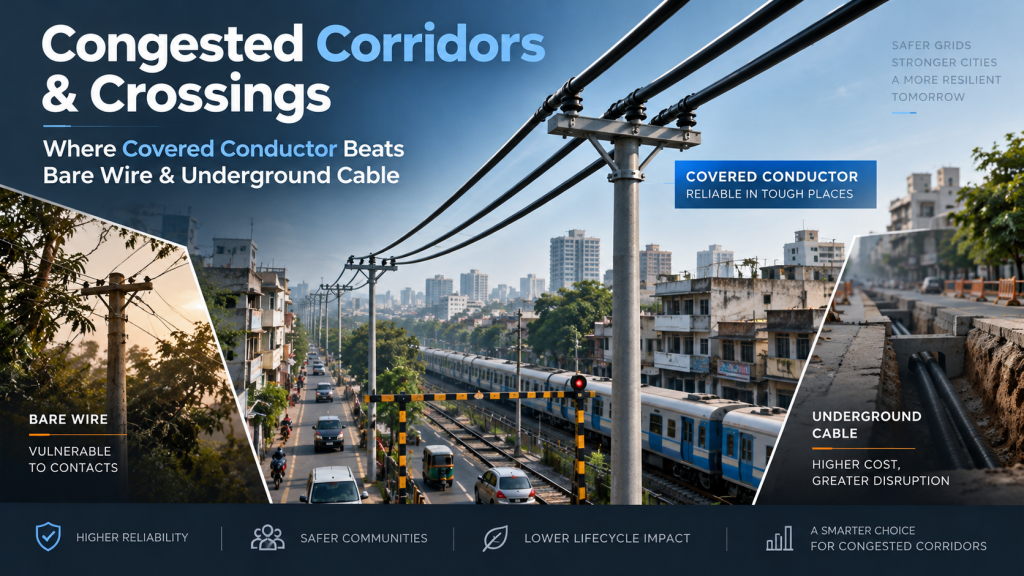
Concentric Cables: The Engineering Answer to Power Theft
Somewhere tonight, someone with a bamboo pole and a hook of wire is helping himself to a distribution feeder. Utilities call the result “commercial losses” and it costs them a meaningful slice of everything they generate. Enforcement chases it, meters get smarter — and cable design can simply make the theft not worth attempting. That’s the whole idea of the concentric service cable.
Picture an ordinary two-core service drop: phase and neutral side by side, either one a knife’s width away. Now the concentric version. The phase runs down the centre, insulated. The neutral isn’t a second core at all — it’s a complete layer of wires stranded around the phase, with the sheath over that. There is no point along the cable where you can reach the phase without first cutting through the energised neutral. That’s hard to do, unpleasant to attempt, and — this is the part that matters to a utility — it shows. Disturb the neutral and the metering end knows.
Utilities specify the layer two ways, and it’s a network decision rather than a preference. CNE — combined neutral and earth — uses the one concentric layer for both jobs, which keeps the house-service cable compact. SNE keeps neutral and earth as separate wire sets within the same layer. Internationally the family sits under BS 7870 Part 3.
The anti-theft story gets the attention, but the geometry is quietly good engineering anyway. The cable is compact for its rating. The neutral layer doubles as mechanical armour for the phase. One cable replaces a pair of service wires at poles that are already carrying too much. Standard sizes run 1×6/6 up to 1×25/25 — phase and concentric neutral cross-sections — and bigger or multi-core builds are made to order.
Our UNIDAC range was developed for exactly the markets where pilferage does the most damage — utility house-service work across Africa and Latin America — in both CNE and SNE, with communication pairs if the network wants them. The details live on the concentric anti-theft cables page, and there’s more on the construction in our armouring guide.
Related
EN 45545-2 on Rail Harnesses: What Fire Compliance Means for the Cables Inside
Conductor Clashing on Overhead Lines: Why Wind Trips Feeders and What Covered Conductor Changes