
Home Inverter Wiring: Battery Cable, Backup Circuits and the Wire Sizes Behind Reliable Backup
An 800 W load on a 12 V home inverter pulls close to 80 A from the battery. The same load draws under 4 A from the 230 V mains. That difference, a current roughly twenty times higher on the battery side, is why the short cable between the battery and the inverter is the most demanding piece of wire in many Indian homes, and why it is so often the part that is undersized.
Most inverter complaints that reach an electrician (backup that ends early under load, a lug that discolours, an RCCB that trips only when the inverter takes over) trace back to three wiring decisions: the battery cable, the way the backup circuits are separated from the mains circuits, and the size of wire used on the inverter’s AC input and output. Each has a straightforward engineering answer.
The battery cable: low voltage, high current
Power is voltage multiplied by current. At 12 V, every 100 W of load needs a little over 8 A from the battery before inverter losses are counted. Taking an inverter efficiency of 85% as a working assumption, an 800 W load needs about 78 A at 12 V, or about 39 A on a 24 V system. Inverter makers publish their own efficiency figures, and the manual governs.
That current flows out and back, so a battery placed 1.5 m from the inverter puts 3 m of conductor in the loop. With 16 sq mm copper at the 1.21 ohm per km published for APAR Class 5 house wire, the loop resistance is about 0.0036 ohm. At 78 A the voltage lost in the cable is about 0.28 V, which is 2.4% of a 12 V supply, and the cable itself turns about 22 W into heat. With 10 sq mm (1.91 ohm per km) the drop rises to about 0.45 V, or 3.7%.
A few tenths of a volt sound trivial, but at 12 V they matter. The inverter measures the voltage at its own terminals, not at the battery. As the battery discharges under load, the cable drop pushes the voltage the inverter sees toward its low-battery cut-off sooner than the battery alone would. A thin or long battery cable can therefore shorten usable backup on a heavy load even when the battery itself is healthy. Loose or poorly crimped lugs add resistance at exactly the same point, and they concentrate the heat in one spot rather than spreading it along the cable.
Current rating is the second check, and it can rule out a size that looks adequate on voltage drop. In APAR’s published table, 16 sq mm Shakti FR LSH is rated 62 A clipped, so the 78 A in the example above is beyond it. Each grade has its own published ratings, and the figure for the grade actually being installed is the one to use. Shakti FR LSH and Anushakti HR FR PVC both list battery circuits among their applications, with sizes up to 16 sq mm. Where the inverter’s DC current is higher than the house-wire range can carry, flexible APAR battery cables run from 1.5 sq mm up to 240 sq mm.
APAR recommends the following for the battery link:
- Use the cable size and lug type stated in the inverter manual as the minimum, then check both the current rating and the voltage drop for the actual length.
- Keep the battery close to the inverter and keep the positive and negative cables the same length and routed together.
- Crimp lugs with the correct die for the conductor size, and tighten battery terminals to the battery maker’s instruction.
- Fit a fuse or DC breaker near the battery where the inverter maker specifies one.
- Place flooded lead-acid batteries in a ventilated spot, because they release hydrogen while charging, and keep cable ends clear of the battery top.
Backup circuits: keep the two supplies apart
A home inverter usually backs up a selected set of circuits, typically lights, fans and a few sockets, rather than the whole house. There are two common arrangements. In the first, the backup points are wired on their own circuits from the start, so the inverter output feeds a small group of MCBs. In the second, an existing house is converted by moving chosen circuits onto the inverter output at the distribution board.
Either way, two rules apply. The inverter output must never be connected to wiring that is also fed by the mains at the same moment; the inverter’s internal changeover handles the transfer, and a second, improvised path can back-feed the incoming supply. And each circuit’s phase and neutral must stay together. When a backup circuit takes its phase from the inverter but returns its neutral through a different RCCB or to the mains neutral bar, the RCCB sees unequal currents and trips. This is the usual cause of an RCCB that trips only on inverter power, and the fix is in the wiring, not the RCCB.
A converted house is where these mistakes cluster, because circuits that once shared a neutral are split between two supplies. The wiring changes at the board should be drawn out first, and every backup circuit traced end to end before the inverter is switched in.
The AC side: input and output wire sizes
On the 230 V side the currents are modest. A 1 kVA inverter delivers about 4.3 A at full output (1,000 VA divided by 230 V). The input is busier: when mains returns, the inverter passes the backup load through to its output and recharges the battery at the same time, so the input wire carries both. The charging current depends on the inverter and the battery bank, and the manual states it.
The practical approach is to treat the inverter input as a dedicated circuit with its own MCB, chosen to the input current the maker specifies, and to size the wire to that MCB using the in-conduit column of the product table, since most inverter supplies run concealed. The MCB rating to wire size chart covers the pairing. Using a clipped rating for a wire that will run in conduit overstates what it can carry.
Output circuits are sized like any other lighting or socket circuit, on the load they serve. Where a backup circuit runs a long distance, the voltage drop arithmetic in the house-wire conductor and resistance chart applies here too.
Which wire grade for the backup wiring
Backup circuits are fixed wiring like the rest of the house and run through the same walls, ceilings and stairwells. There is no reason to drop to a lower insulation grade because a circuit is fed from an inverter. The grade specified for the rest of the building, whether Anushakti HR FR LSH for heat resistance with low smoke and low halogen, or Anushakti Fire Protekt where halogen-free insulation is required, should carry through to the backup circuits.
The inverter corner itself deserves the same attention. Inverters and batteries often sit under a staircase or in a utility space, a confined area where a hot lug or a damaged cable can go unnoticed. A neat installation, with cables clipped, lugs covered and the battery accessible for inspection, is easier to check and safer to live with.
A short checklist before handover
- Battery cable size and lugs match or exceed the inverter manual, and the voltage drop has been checked for the actual length.
- Battery terminals are tight and clean, with a fuse or DC breaker fitted where specified.
- The inverter input is on its own MCB, with wire sized to that MCB using the in-conduit rating.
- Every backup circuit takes both phase and neutral from the inverter output side.
- No backup point is also connected to a mains-fed circuit.
- The RCCB has been tested on mains and on inverter power.
For appliance-by-appliance wire sizes on the mains side, the wire size for home appliances chart sets out the usual circuit sizes. APAR’s technical team can advise on battery cable and house-wire selection for a specific inverter installation.
Related
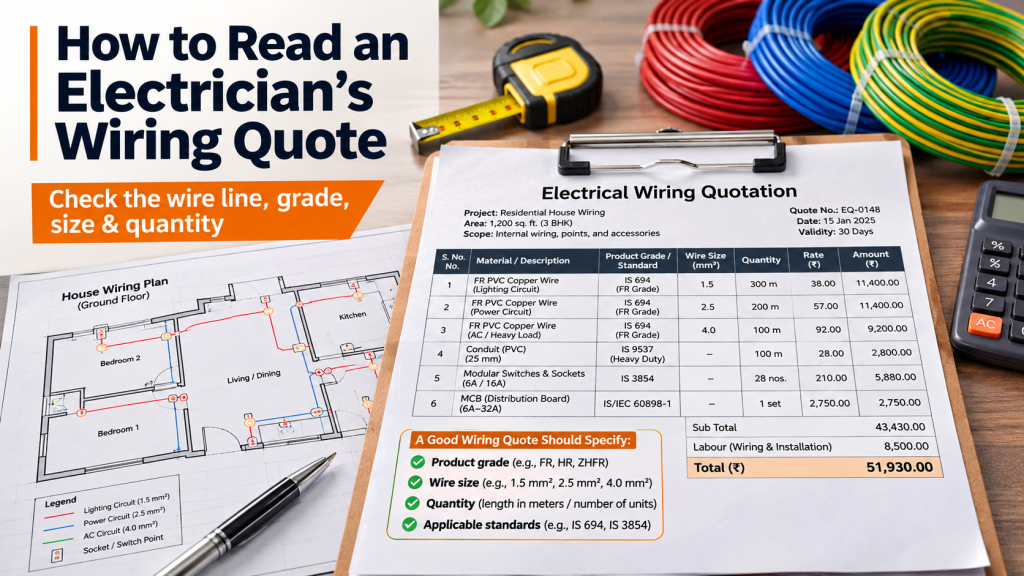
How to Read an Electrician’s Wiring Quote: The Wire Line That Decides What Is Behind Your Walls
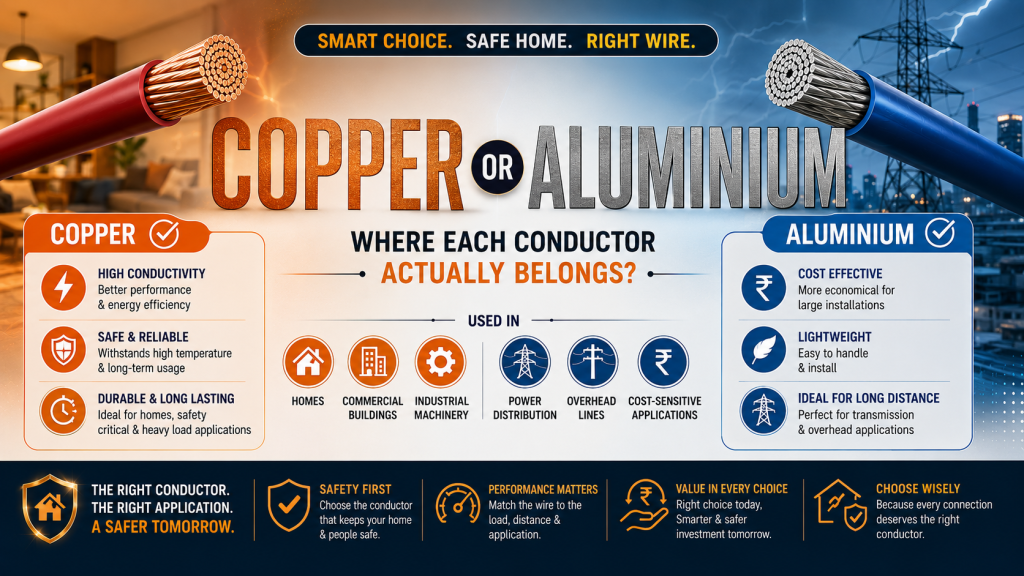
Copper or Aluminium? Where Each Conductor Actually Belongs