Safest House Wire in India: The Numbers That Actually Decide It
Every wire sold in India is described as safe. Very few publish the measurements that would let you check. If you want the safest house wire for your home, the useful question is not which brand claims it — it is which numbers the manufacturer is willing to print.
Here are the four that matter, what they mean, and the thresholds worth insisting on.
Why smoke matters more than flame
In most fatal house fires, people are overcome by smoke and toxic gas before flame reaches them. Wiring runs through every room, ceiling void and stairwell in the building — the exact paths people use to escape.
When ordinary PVC insulation burns it produces dense black smoke and hydrogen chloride gas. The smoke removes visibility in seconds. The gas attacks the lungs and corrodes metal, which is why it also destroys electronics in rooms the fire never reached.
This is the problem low-smoke and halogen-free compounds were created to solve.
1. Oxygen index — will it keep burning on its own?
The oxygen index is the minimum oxygen concentration needed to sustain combustion. Ordinary air is about 21% oxygen.
A material with an oxygen index above 21% cannot keep burning in normal air once the ignition source is removed — it self-extinguishes. Look for ≥ 29%; a strong HFFR compound reaches 31% or higher. The higher the figure, the harder the wire is to keep alight.
2. Temperature index — at what heat does it ignite?
The temperature index is the temperature at which the material will burn in normal air. A good figure is ≥ 250°C. This matters in a developing fire, where surrounding temperatures climb long before flame arrives at the cable.
3. Smoke density — can you still see the door?
Measured to IEC 61034, expressed as smoke density. Lower is better — a strong halogen-free compound reaches around 10%, against roughly 60% for a standard PVC grade. This is the number that decides whether a corridor stays usable.
This is the single parameter most directly connected to whether people get out.
4. Halogen content — the toxic and corrosive part
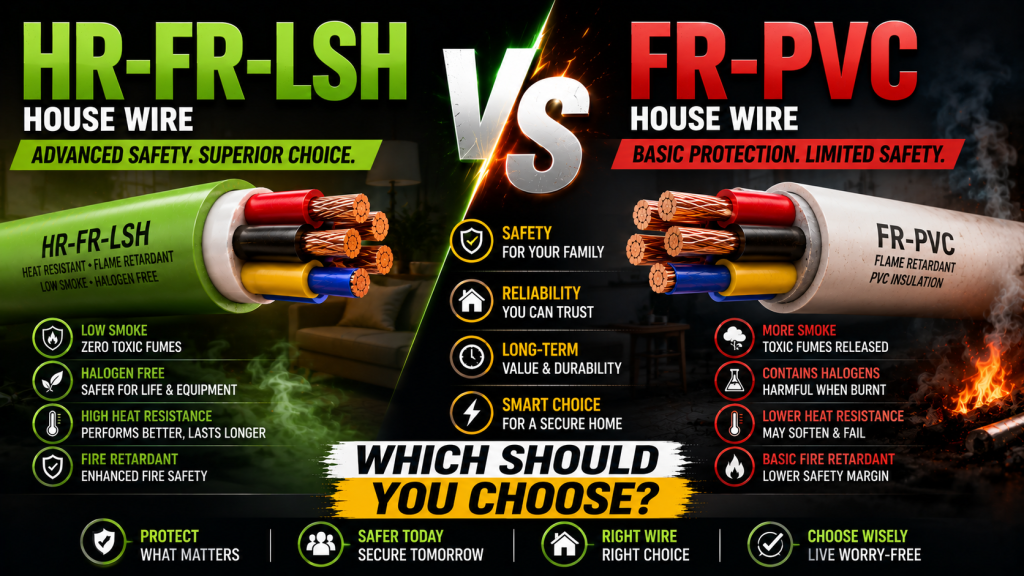
Halogens (chlorine, fluorine, bromine) are what make burning PVC dangerous beyond the heat. A genuinely halogen-free compound tests at ≤ 0.5%.
Be precise with terminology here, because the labels are easy to blur:
- Low halogen / LSH — reduced, not eliminated.
- Halogen-free / HFFR — essentially none, and certified under IS 17048:2018.
If a wire is described as halogen-free, ask for the measured figure. “Low smoke, low halogen” and “halogen-free” are different products at different price points.
How the APAR house-wire range compares
Rather than describe this in the abstract, here is APAR’s own published fire-performance data across the range, so you can see how the grades actually differ:
| Wire | Grade | Oxygen index | Smoke density | Acid gas / halogen | Temp rating |
|---|---|---|---|---|---|
| APAR Shakti FR-PVC | FR | ≥ 29% | ≤ 60% | ≤ 20% | 70°C |
| APAR Shakti FR-LSH | FR-LSH | ≥ 29% | ≤ 60% | ≤ 20% | 70°C |
| APAR Green Wire HR-FR-LSH | HR-FR-LSH | ≥ 29% | ≤ 60% | ≤ 20% | 85°C |
| Anushakti HR-FR-PVC (e-beam) | HR-FR-PVC | > 29% | 75% | 20% | 105°C |
| Anushakti HR-FR-LSH (e-beam) | HR-FR-LSH | > 29% | 75% | 20% | 105°C |
| Anushakti Fire Protekt EBXL HFFR | HFFR | ≥ 31% | ≤ 10% | ≤ 0.5% | 120°C |
The pattern is worth reading carefully. Across the PVC-based grades the fire numbers are broadly similar — the differences are in heat rating and features like rodent resistance. The step change comes with HFFR: smoke density falls from around 60% to 10%, and halogen from 20% to 0.5%.
That is the difference between a corridor you can see through and one you cannot, and it is why the halogen-free grade exists.
The standard behind the claim
IS 17048:2018 is the Indian Standard for halogen-free flame retardant cables up to 1100 V. BIS certification under it is mandatory for HFFR cable sold in India. Standard PVC house wires — FR and FR-LSH grades — fall under IS 694:2010 instead.
A wire claiming HFFR performance should be able to name IS 17048 and show a BIS licence number printed along the insulation.
Where the safest wire matters most
Fire-safety grade is worth paying for anywhere evacuation is slow or crowded:
- High-rise apartments, where the only way out is an enclosed stairwell
- Hospitals, schools and anywhere with occupants who cannot self-evacuate quickly
- Basements, server rooms and data closets with no natural ventilation
- Homes with elderly residents, young children, or a single exit route
How to actually check before you buy
- Ask for the datasheet — not the brochure. It should list oxygen index, temperature index, smoke density and halogen content.
- Check the certification standard: IS 694:2010 for PVC grades, IS 17048:2018 for genuine HFFR.
- Read the printing on the wire itself. Grade, size, voltage, standard and BIS licence number should all be there.
- Compare like with like. An FR wire and an HFFR wire are not competing products.
The safest wire is not the one with the boldest claim. It is the one whose manufacturer publishes the measurements and prints the licence number where you can read it.
Compare the specifications yourself
Every APAR house wire publishes its full specification — conductor construction, resistance in Ω/km, fire-performance figures, applicable standards and current ratings for both conduit and clipped installation:
- Anushakti Fire Protekt EBXL HFFR — halogen-free, e-beam cross-linked, 120°C
- Anushakti HR-FR-LSH — e-beam, heat-resistant to 105°C, low smoke
- Green Wire HR-FR-LSH — eco-friendly compound, rodent and termite resistant
- Shakti FR-LSH — flame-retardant, low smoke, low halogen
Use the comparison to judge APAR against any other manufacturer. If a competitor cannot supply the same figures, that itself tells you something.
Compare cables side by side → | Size your circuits with the wire calculator →
Related reading
- Choosing a house wire: the full buying guide. How the safety numbers fit into a buying decision.
- What the codes on the label mean. ISI, FR, FRLS, HFFR and HR.
- Anushakti Fire Protekt. Published fire-performance figures.